Best 9mm Self-Defense Ammo
Defensive ammunition is the one ammo purchase where price should not decide. Here is what separates a serious load from a marketing exercise, and how to verify it in your own pistol.

Everything about buying defensive ammunition is different from buying practice ammunition. The quantity is small, the price is irrelevant at that quantity, and the failure mode is not "I overpaid" — it is "it did not work."
So the process inverts. Instead of optimizing price and accepting any functional product, you specify the product and accept the price.
What separates a serious load from a marketing exercise
Consistent expansion across barriers
The performance standard the industry benchmarks against involves firing into calibrated gelatin through a range of intermediate barriers — bare gel, heavy clothing, and various hard barriers. A load that expands beautifully through bare gel and plugs solid through denim is not a load you want.
Loads that are genuinely well-regarded share a common trait: they perform consistently across barrier types rather than spectacularly in one condition.
Adequate penetration
The widely used benchmark is 12 to 18 inches of penetration in calibrated gel. Under-penetration is the more common failure in defensive handgun ammunition — a bullet that opens up violently and stops short has not reached what it needed to reach. Over-penetration is a real but secondary concern.
Bonded or mechanically locked construction
Bonded bullets — where the jacket is chemically fused to the core — hold together through barriers rather than shedding the core. This is the single most reliable predictor of consistent performance through clothing and other intermediate barriers.
Barrel length changes the answer
This is the most under-appreciated variable in defensive ammunition selection.
| Barrel length | Typical platform | Selection priority |
|---|---|---|
| 3 inches or less | Pocket pistols, micro-compacts | Loads specifically engineered for short barrels |
| 3.1 - 3.9 inches | Subcompact carry guns | Short-barrel loads or proven standard-pressure designs |
| 4.0 - 4.5 inches | Compact / carry guns | Widest range of options performs well |
| 4.6 inches and up | Full-size and duty | Any well-designed load; +P is a viable option |
A hollow point is a velocity-dependent machine. Below its design threshold the cavity does not open, and you are carrying an expensive full metal jacket with a hole in the nose. Manufacturers now build short-barrel-specific loads precisely because this problem is real.
The +P question
+P ammunition runs at higher pressure and delivers higher velocity. In a full-size pistol, that extra velocity can push a bullet design further into its reliable expansion window, and the added recoil is manageable.
In a subcompact, you get less of the velocity benefit (short barrel, less time to accelerate) and more of the cost (sharper recoil in a light gun, more muzzle flash in low light, faster wear). It is not that +P is wrong in a small gun — it is that the trade is worse.
Never use +P for practice volume. It wears the gun faster for no training benefit.
The verification process
This is the part people skip, and it is the part that matters.
- Buy two boxes. One to test, one to carry.
- Fire 50 rounds through the pistol you actually carry, using the magazines you actually carry.
- Include a fouled gun. Test late in a range session, not with a freshly cleaned pistol.
- Check point of impact at 15 and 25 yards against your practice load. They will often differ.
- Load and mark. Note which round is chambered. Rotate it rather than re-chambering the same round repeatedly — bullet setback raises pressure.
- Rotate annually.
If you get an unexplained malfunction in those 50 rounds, that combination of gun, magazine and load has told you something. Test another 50 or pick a different load.
What we track
Defensive loads move in and out of stock constantly, and pricing on them is far less stable than on practice ammunition. Here is what is currently available across the retailers we monitor:
9mm Defensive Loads In Stock Now
Prices updated Oct 10, 2026
CCI Blazer Brass 9mm 115 Grain 20-Rounds JHP
9mm · 115gr · 20 rds

Norma Self Defense NXD Brass 9mm 65 Grain 20-Rounds
9mm · 65gr · 20 rds

MagTech Steel Case 9mm 115 Grain 50-Rounds FMJ
9mm · 115gr · 50 rds
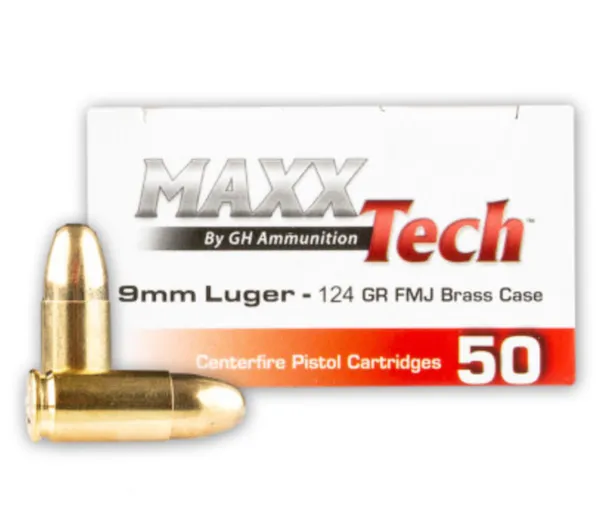
TulAmmo MaxxTech Brass 9mm 124-Grain 50-Rounds FMJ
9mm · 124gr · 50 rds

SinterFire Special Duty Brass 9mm 100-Grain 20-Rounds HP
9mm · 100gr · 20 rds

Winchester USA Forged Steel 9mm 115-Grain 50-Rounds FMJ
9mm · 115gr · 50 rds

Wolf Performance Ammo Steel 9mm 124 Grain 50-Rounds FMJ
9mm · 124gr · 50 rds

Sterling Steel Case 9mm 115 Grain 50-Rounds FMJ
9mm · 115gr · 50 rds

Sellier & Bellot XRG Defense Copper 9mm 100-Grain 25-Rounds HP
9mm · 100gr · 25 rds
9mm Luger Price Index
Live · Oct 10, 2026The index above is dominated by practice ammunition — defensive loads sit well above the market average, which is exactly as it should be.
Practice ammunition to pair with it
Train with something that recoils like what you carry. If you carry a 124gr defensive load, buy 124gr FMJ practice ammunition rather than defaulting to whatever 115gr is cheapest.
9mm Practice Ammo by Cost Per Round
Prices updated Oct 10, 2026
MAGTECH 9mm Luger Steel Case 124 FMJ 50rd
9mm · 50 rds

SELLIER BELLOT 9mm 124Gr 1200 FPS FMJ 50rd
9mm · 124gr · 50 rds

SELLIER BELLOT 9mm 115gr FMJ Brass Ammunition | 50 Rounds
9mm · 115gr · 50 rds
MAGTECH 9mm 124gr FMJ 50rd
9mm · 124gr · 50 rds

Winchester USA Forged 9mm 115 Grain 1000-Rounds Bulk FMJ
9mm · 115gr · 1,000 rds

MILI CUSTOM DEFENSE AMMUNITION 9mm 155gr Subsonic FMJ 50rd
9mm · 155gr · 50 rds
Full practice-ammo breakdown in best 9mm ammo.
Get alerted when 9mm price drops hit.
We watch every listing and email you the moment the cost per round drops.
Set Up a Free Price AlertAmmoSpotter earns a commission when you buy through links on this page. It never changes what you pay, and it never decides what we recommend — our picks are ranked on live cost-per-round data pulled from every retailer we track. Full disclosure.
Frequently Asked Questions
How many rounds should I test before carrying a defensive load?+
Is a heavier bullet better for self defense in 9mm?+
Does barrel length change which defensive ammo I should buy?+
Should I carry +P ammunition?+
How often should I replace my carry ammo?+
Shop the data

About the author
AmmoSpotter Research Desk
Price & Ballistics Research
The AmmoSpotter Research Desk analyzes live retail pricing across every ammunition, firearm and accessory listing we track. Recommendations here are ranked against real cost-per-round data pulled daily from the retailers we monitor - not against manufacturer marketing copy.
- ✓Tracks 180,000+ live product listings across 6 retailer feeds
- ✓Records price history on every listing, every day
- ✓Cost-per-round methodology applied to all ammunition rankings
- ✓No product is ranked without a verifiable in-stock retail price
- ✓Affiliate relationships never influence rankings
Related Guides

Best 9mm Ammo 2026: Range, Carry and Duty Loads Ranked
9mm Luger is the most-produced, most-competitive cartridge in the American market. That is good news and bad news: prices are low, and the sheer number of listings makes it easy to pay 30% more than you needed to for ...

9mm vs .45 ACP: The Honest Comparison (With Live Prices)
This debate has outlived its usefulness, largely because both sides argue about terminal ballistics — the area where the difference is smallest — and ignore the areas where the difference is enormous. Let us do it the...

Cost Per Round: The Only Ammo Price Metric That Matters
There is exactly one reason ammunition is hard to price-compare: it is advertised in boxes and consumed in rounds. Box counts are not standardized. A "box" of 9mm might be 50 rounds. A "value pack" might be 100, or 11...
Best 9mm Ammo for a Subcompact or Micro Pistol: Short-Barrel Loads on Live Prices
A micro-compact 9mm solves the carry problem. It fits inside the waistband, holds enough rounds, and disappears under a T-shirt. What it gives up is barrel length, and in a handgun cartridge barrel length is velocity....

115gr vs 124gr vs 147gr 9mm: Which Bullet Weight Should You Buy?
Grain weight is the first spec on a 9mm box and the one people overthink most. Three loadings dominate the market — 115, 124 and 147 grain — and the actual differences between them are smaller than the internet sugges...

Terminal Ballistics: Expansion, Penetration and What Gel Tests Show
- Ballistic gelatin is a calibration medium , not a tissue substitute. It exists so two bullets can be compared fairly, not so a number can be quoted at you. - Expansion and penetration trade against each other. The p...