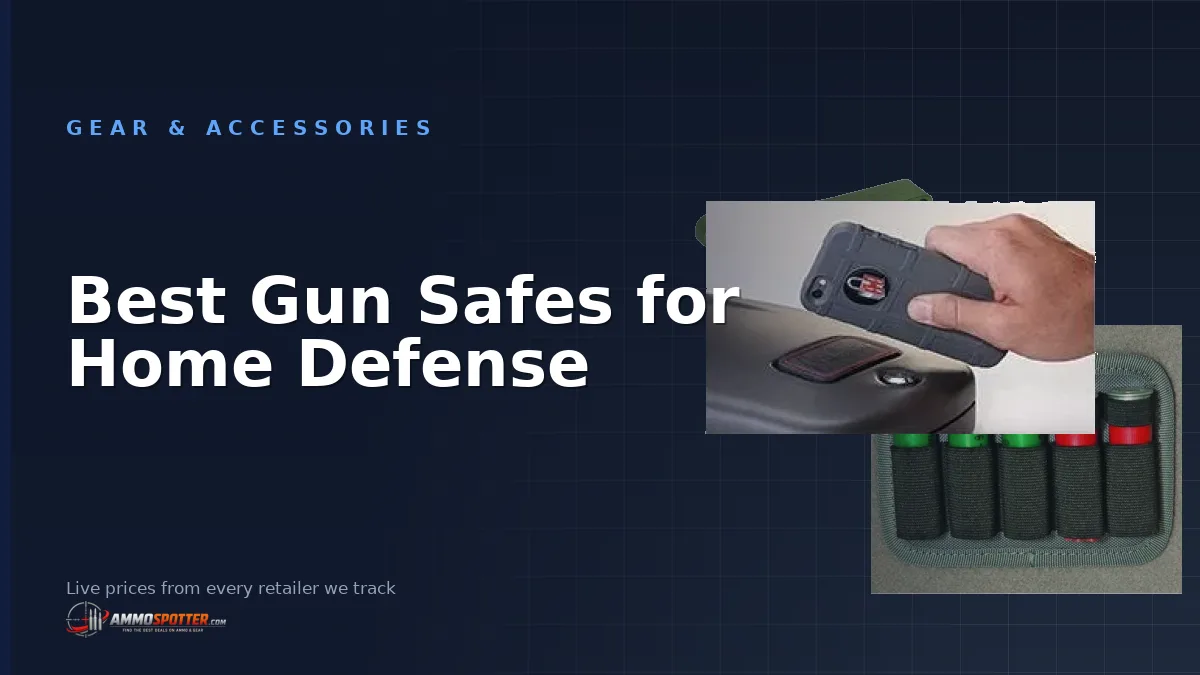
Best Gun Safes for Home Defense 2026: What the Price Data Says to Buy
Home defense needs a quick-access vault, not a big gun safe. Here's what they cost, keypad vs fingerprint, why to bolt it down, and why you should shop around.
23 results
Home defense needs a quick-access vault, not a big gun safe. Here's what they cost, keypad vs fingerprint, why to bolt it down, and why you should shop around.
Most appendix holsters are IWB holsters that work in either spot, so your gun usually decides. Revolvers and 1911s go strong side. Here's what each option costs.
Most carry revolvers cost $250 to $399. Here's how Taurus, Charter, S&W, Ruger and Colt compare, why .38 beats .357 for most, and where to save.
Cheap .45 ACP is 230-grain FMJ in 100-round boxes or bulk, about a third of the typical price. Here's how to find it, and why sorting by box price steers you wrong.
For bear country, carry heavy 200–220 grain hard cast or flat nose. For deer and hog, use a bonded expanding bullet. Practice with cheap 180-grain FMJ, but test your carry load.
For a snub .38, buy cheap 50-round practice boxes and one short-barrel defensive load. Here's what each costs and why box price fools people.
Gel tests compare bullets, they don't mimic a body. Here's how to read penetration and expansion numbers, and what better bullet engineering costs you.
A micro pistol's short barrel slows hollow points. Here's how to pick a short-barrel carry load, whether to use +P, and why 50-round boxes save you money.
FMJ holds together and is cheap, so you practice with it. Hollow points expand and stop in the target, so you carry them. Soft points expand at rifle speed, so you hunt with them.
Your ammo stock has three parts: practice ammo, a small defensive reserve, and a few months of buffer for price spikes. Here's how to size each one and what it costs.
A safe carry holster covers the trigger, holds the gun, stays open and sits in one spot. Here's how to pick one, what it costs, and why the belt matters.
The shotgun is the cheap part. Here's what defensive pumps and semi-autos cost, how 12 and 20 gauge compare, and where your money really goes.
The gun is the cheap part. Here's how to pick a first handgun that fits, why 9mm is the default, and how to budget for 500 rounds of practice.
The Glock 19 shoots best, the P365 hides best, and the Shield Plus splits the difference for less. Here's how to choose, with live prices.
Taurus, Ruger, Hi-Point, S&W, cheap revolvers and budget 1911s at live prices, plus the frame-listing trap and why your first budget gun should be 9mm.
Skip MSRP. Here's what carry pistols cost at street price, what you give up under $300, where most people should buy, and why ammo matters more.
Carry the caliber you shoot well. Carry ammo is one magazine, so practice ammo decides your cost. For most people, that makes 9mm the pick.
Small boxes hide how pricey buckshot is per shot. Here's how to choose between 00, #1 and #4 buck, pattern your gun, and buy only what you need.
The cheapest 5.56 is almost all military FMJ, the wrong bullet indoors. Here's what to load instead, why barrel length matters, and how much to buy.
115 and 124 grain 9mm trade places as the cheapest practice ammo. 147 grain is for suppressors and duty loads. Here's which weight to buy for each job.
Price shouldn't pick your carry ammo. Here's what makes a good 9mm defensive load, how barrel length and +P change the choice, and how to test it.
9mm is cheap and easy to find, but it's easy to overpay. Here's what to buy for practice, carry and duty, 115gr vs 124gr, and when bulk really saves you money.
For most shooters, 9mm is the better choice: cheaper, more rounds and less recoil. The .45 ACP's wider bullet is a small edge, not a big one.