115gr vs 124gr vs 147gr 9mm
Three weights, one cartridge, and a price gap that decides the question for most buyers. Here is what our live catalog says about what each weight actually costs.

Grain weight is the first spec on a 9mm box and the one people overthink most. Three loadings dominate the market — 115, 124 and 147 grain — and the actual differences between them are smaller than the internet suggests for range work, and larger than most people expect for suppressed shooting.
The useful question is not which weight is best. It is which weight is best for the specific job, at the price it costs today.
What the live price data says about each weight
Start with the market, because it settles the argument for anyone buying in bulk:
9mm Luger Price Index
Live · Nov 18, 2026We are tracking 679 live 9mm listings across our retailers. The average cost per round across all of them sits well above the floor, because that number includes premium defensive and hunting loads that run several times the price of range ball — the most expensive 9mm listing in the catalog is more than fifteen times the cheapest.
The more revealing cut is the bottom of the market. Looking at the 25 cheapest 9mm listings we currently track:
| Bullet weight | Listings in the cheapest 25 |
|---|---|
| 115gr | 16 |
| 124gr | 7 |
| 147gr | 1 |
| Other (155gr) | 1 |
That single 147 grain entry is a Silvertip hollow point, not practice ammunition. It is the cheapest 147 grain we track — and it is still more expensive per round than a dozen 115 and 124 grain ball loads sitting above it in the list.
115 grain: the practice default
The lightest of the three common weights and the highest velocity. It is what most manufacturers load when the goal is cheap, plentiful, reliable range ammunition, and volume is exactly why it sits at the bottom of the price range.
Practical characteristics:
- Fastest of the three. Higher muzzle velocity, flatter over the short distances handguns are actually used at — a difference you will not see on a target at 15 yards.
- Sharper recoil impulse. Less mass moving faster tends to read as a snappier, more abrupt push. Some shooters prefer it, most do not notice.
- Widest availability. Every major manufacturer loads it, in brass, steel and aluminum cases, in every box size from 50 rounds to a 1,000-round case.
If you are buying ammunition to shoot into a berm, this is the default. The only reason to deviate is price — and sometimes 124 grain undercuts it.
Cheapest 9mm Right Now, Any Weight
Prices updated Nov 18, 2026
MAGTECH 9mm Luger Steel Case 124 FMJ 50rd
9mm · 50 rds
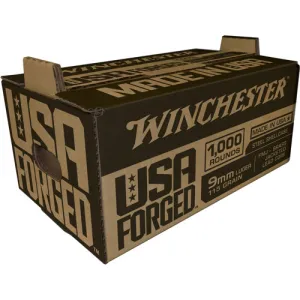
Winchester USA Forged 9mm 115 Grain 1000-Rounds Bulk FMJ
9mm · 115gr · 1,000 rds

MILI CUSTOM DEFENSE AMMUNITION 9mm 155gr Subsonic FMJ 50rd
9mm · 155gr · 50 rds
Aguila Centerfire Handgun Bulk 9mm 115 Grain 300-Rounds FMJ
9mm · 115gr · 300 rds
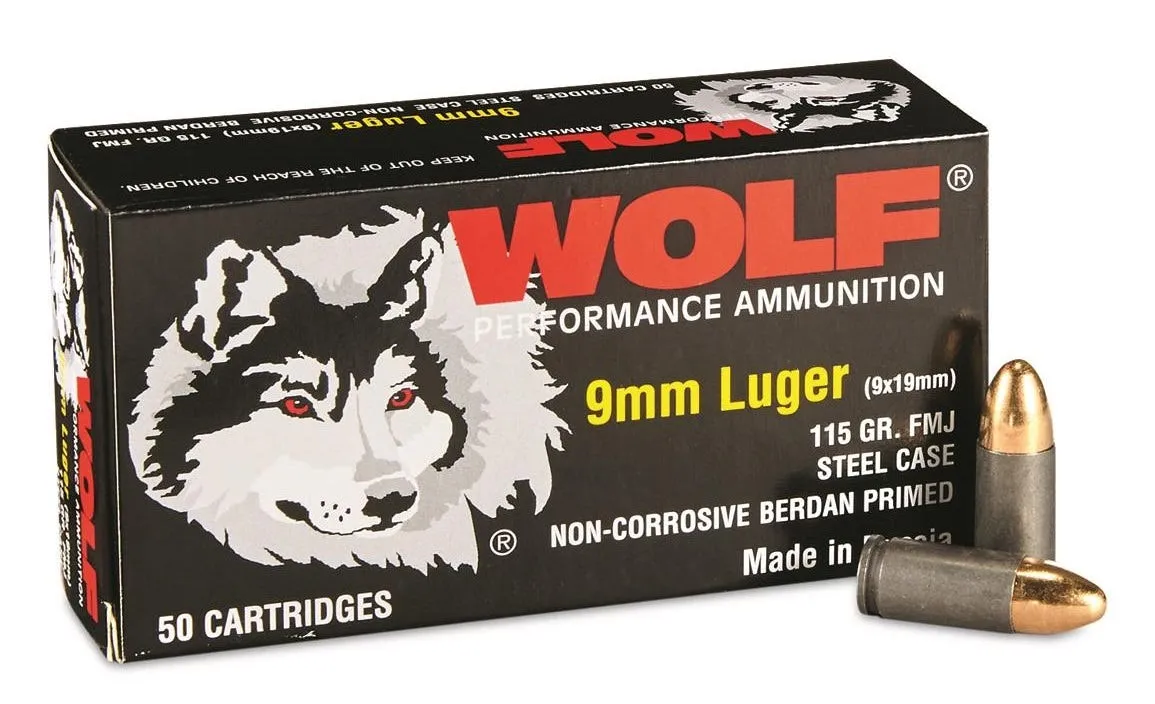
Wolf Performance Ammo Centerfire Handgun Steel 9mm 115-Grain 50-Rounds FMJ
9mm · 115gr · 50 rds
AMMO INC 9mm ZSR 124Gr Full Metal Jacket 50rd
9mm · 124gr · 50 rds
124 grain: the NATO standard
124 grain is the weight NATO settled on, and it is the standard duty loading for a large share of the world's militaries and police forces. That pedigree is real, but it does not make the round meaningfully better on a range trip.
What it actually gives you:
- More momentum at lower velocity. Slightly more bullet mass moving slightly slower, which many shooters describe as a rolling push rather than a snap.
- Better slide cycling in some pistols. Guns tuned around NATO-pressure ammunition — particularly some compact and suppressed setups — sometimes run more reliably on 124gr than on light practice loads.
- The reference weight for a lot of duty ammunition. If your carry load is 124gr, matching practice ammunition weight keeps your point of impact and felt recoil closer to what you carry.
That last point is the strongest argument for buying 124 grain practice ammunition, and it is worth more than the ballistics. Training with the impulse you carry is worth a couple of cents a round.
Bulk 9mm - 500 Rounds and Up
Prices updated Nov 18, 2026Winchester USA Forged 9mm 115 Grain 1000-Rounds Bulk FMJ
9mm · 115gr · 1,000 rds
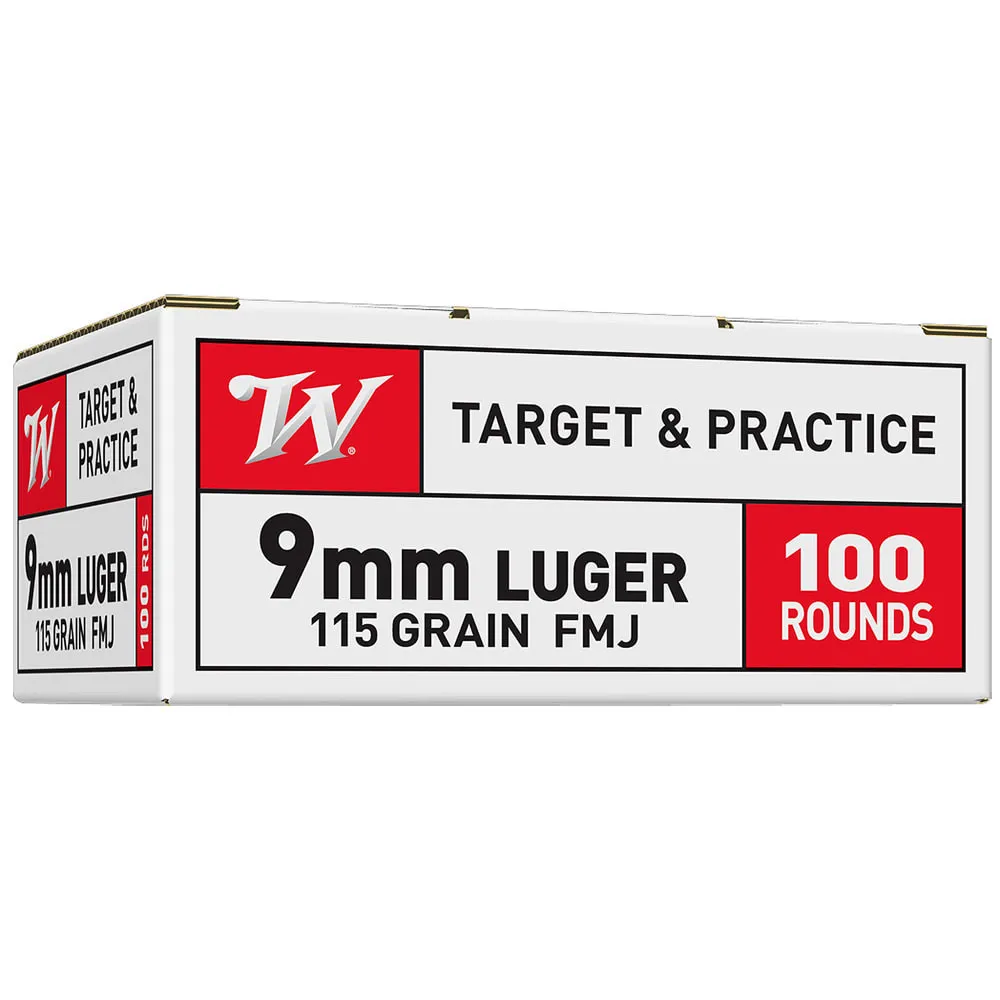
Winchester 9mm Target & Practice FMJ 115gr Case of 1000rds USA9MMVP
9mm · 115gr · 1,000 rds

CCI Ammunition Blazer Aluminum 9mm 115-Grain 1000-Rounds Bulk FMJ
9mm · 115gr · 1,000 rds

PMC Ammunition Bronze Brass 9mm 124 Grain 1000-Rounds Bulk FMJ
9mm · 124gr · 1,000 rds

Winchester Centerfire Handgun Brass 9mm 115-Grain 1000-Rounds FMJ Bulk
9mm · 115gr · 1,000 rds

PMC Ammunition Bronze Brass 9mm 115-Grain 1000-Rounds Bulk FMJ
9mm · 115gr · 1,000 rds
147 grain: the suppressor and duty weight
147 grain is where the picture actually changes, and it is the one weight with a job the other two cannot do.
The heavier bullet reaches useful energy at a velocity below the speed of sound, which is what makes it the standard starting point for suppressed shooting. A supersonic bullet produces a crack downrange that no suppressor can eliminate; a subsonic one does not. That is the entire reason a subsonic loading exists.
Two cautions that get missed constantly:
- Not all 147gr is subsonic. Some 147 grain loads are pushed fast enough to break the sound barrier out of a longer barrel. Read the stated muzzle velocity on the box — you want it comfortably under roughly 1,050 fps, with margin for temperature and barrel length.
- Not all subsonic is 147gr. Heavier loadings exist, and some lighter ones are loaded down deliberately. Grain weight is a proxy, not the specification.
The other place 147 grain shows up is duty and defensive ammunition, where the heavier bullet is often selected for consistent penetration through intermediate barriers. That is a manufacturer engineering choice, not something a buyer can evaluate from the box.
We do not run our own terminal ballistics testing, and we will not pretend otherwise. What we can tell you is what each load costs across every retailer we track, which is the part nobody else publishes. Our reasoning for that line is in how we rank ammunition.
If suppressed shooting is the reason you are here, the full breakdown of what actually goes quiet is in best ammo for suppressed shooting.
Head to head
| 115gr | 124gr | 147gr | |
|---|---|---|---|
| Velocity | Highest | Middle | Lowest |
| Typical use | Volume practice | Practice and duty | Suppressed, duty, defense |
| Recoil character | Sharper, snappier | Longer push | Slowest, softest push |
| Subsonic | No | Rarely | Commonly |
| Availability at the price floor | Dominant | Frequent | Rare |
| Share of our 25 cheapest listings | 16 | 7 | 1 |
| Best for | Cheap round count | Matching your carry load | Suppressor use |
So which should you buy?
High-volume practice: whichever of 115 or 124 is cheaper today. They are close enough in behavior that the price difference is the only variable worth acting on, and our data shows the two trading places at the floor. Sort by cost per round and take the winner. If you are working through a structured practice plan, the arithmetic on how much that adds up to is in how many rounds does it take to get good.
Matching a carry load: buy the weight you carry. If your defensive ammunition is 124gr, practice with 124gr. The point-of-impact shift between weights is real at distance with fixed sights, and it is a poor thing to discover under stress.
Suppressed shooting: 147gr subsonic, verified by stated velocity. This is the one case where grain weight is genuinely load-bearing, and the one case where paying more per round buys you something specific.
Self-defense: pick the load, not the number. Quality defensive hollow points in all three weights are engineered to hit the same expansion and penetration window. Reliable feeding in your specific pistol and a few hundred rounds of confidence matter more than the grain figure. Our picks are in best 9mm ammo.
Brand matters more than weight at the low end
One thing the catalog makes obvious: the spread between manufacturers at the bottom of the 9mm market is wider than the spread between bullet weights. Winchester and Magtech both reach $0.220 per round in our current data. Federal's cheapest 9mm listing sits at $0.280, Speer's at $0.382, Hornady's at $0.520 — and Buffalo Bore, which loads specialty ammunition rather than range ball, bottoms out at $1.300.
None of that makes the expensive brands worse. It reflects what they are loading. But if your goal is round count, brand selection moves the needle harder than choosing between 115 and 124 grain.
Those gaps also move on a schedule, and not a random one — the forces behind it are laid out in why ammo prices move.
Buy on cost per round, not on the box
Every argument on this page collapses into one habit: convert the listing to landed cost per round, compare it against the current market floor, and let an alert do the waiting instead of refreshing retailer pages.
Cost Per Round Calculator
The only number that matters when comparing ammo. Shipping included.
Get alerted when 9mm price drops hit.
We watch every listing and email you the moment the cost per round drops.
Set Up a Free Price Alert- Every 9mm listing sorted by cost per round
- Best 9mm ammo: range, carry and duty loads
- Best 9mm self-defense ammo
- AmmoSpotter Ammo Price Index
AmmoSpotter earns a commission when you buy through links on this page. It never changes what you pay, and it never decides what we recommend — our picks are ranked on live cost-per-round data pulled from every retailer we track. Full disclosure.
Frequently Asked Questions
Is 124gr 9mm better than 115gr?+
Why is 147gr 9mm harder to find cheap?+
Do I need 147gr for a suppressor?+
Will changing bullet weight shift my point of impact?+
Which 9mm weight is best for self-defense?+
Does bullet weight change how much recoil I feel?+
Shop the data

About the author
AmmoSpotter Research Desk
Price & Ballistics Research
The AmmoSpotter Research Desk analyzes live retail pricing across every ammunition, firearm and accessory listing we track. Recommendations here are ranked against real cost-per-round data pulled daily from the retailers we monitor - not against manufacturer marketing copy.
- ✓Tracks 180,000+ live product listings across 6 retailer feeds
- ✓Records price history on every listing, every day
- ✓Cost-per-round methodology applied to all ammunition rankings
- ✓No product is ranked without a verifiable in-stock retail price
- ✓Affiliate relationships never influence rankings
Related Guides

Best 9mm Ammo 2026: Range, Carry and Duty Loads Ranked
9mm Luger is the most-produced, most-competitive cartridge in the American market. That is good news and bad news: prices are low, and the sheer number of listings makes it easy to pay 30% more than you needed to for ...

Best 9mm Self-Defense Ammo 2026: What to Actually Carry
Everything about buying defensive ammunition is different from buying practice ammunition. The quantity is small, the price is irrelevant at that quantity, and the failure mode is not "I overpaid" — it is "it did not ...

9mm vs .45 ACP: The Honest Comparison (With Live Prices)
This debate has outlived its usefulness, largely because both sides argue about terminal ballistics — the area where the difference is smallest — and ignore the areas where the difference is enormous. Let us do it the...

AmmoSpotter Ammo Price Index: What Ammunition Costs Right Now
Most published ammunition pricing is one of two things: manufacturer MSRP, which nobody pays, or a hand-updated article that was accurate the week it was written. This page is neither. Every figure below is computed a...
9mm vs .40 S&W: Cost, Capacity and Recoil on Live Prices
- .40 S&W costs more per round than 9mm at every tier of the market, and the gap has been stable, not seasonal. - The recoil difference is real and it is about impulse, not raw power. It shows up in split times before...
Ammo Grain Weight Explained: What Bullet Weight Actually Changes
- A grain is a unit of mass — 7,000 to the pound . It describes the bullet only, and it is a specification, not a quality rating. - You are not paying for lead. Within 9mm alone, cost per grain of bullet varies more t...