Ammo Price Alerts: How to Stop Paying Above a Listing's Own Floor
Seven in ten live ammunition listings we track are currently priced above the lowest price we have ever recorded for that exact product. An alert is how you buy at the other number.
Seven in Ten Ammo Listings Cost More Than Their Own Floor
Start with the number that makes the case, because it is not a marketing claim — it is a count.
We hold 12,027 live ammunition listings that pass our quality filters. For each one we store the lowest price we have ever recorded for it since we began tracking in February 2026. Right now:
| Where the listing sits vs its own recorded low | Listings | Share |
|---|---|---|
| At or below its own low | 3,509 | 29.2% |
| Within 2% of it | 491 | 4.1% |
| 2–5% above | 1,182 | 9.8% |
| 5–10% above | 2,246 | 18.7% |
| 10–20% above | 3,075 | 25.6% |
| 20–50% above | 1,392 | 11.6% |
| More than 50% above | 132 | 1.1% |
Read the bottom three rows together: 38.3% of live ammunition listings are at least 10% above a price that product has already sold at. The median listing in the "above its own low" group sits 10.9% up; the mean is 13.8%, pulled by the long tail.
That is not a claim that everything is overpriced. Prices rise for real reasons, and why ammo prices move covers them. It is a narrower and more useful claim: for most products on the shelf today, a cheaper price than the one you are looking at is already a demonstrated fact rather than a hope.
Ammunition Reprices More Than Anything Else We Track
The same measurement across every product type in the catalog:
| Type | Live listings | Above own low | Share |
|---|---|---|---|
| Ammo | 15,812 | 11,036 | 70% |
| Reloading | 9,339 | 6,472 | 69% |
| Outdoor | 19,538 | 8,933 | 46% |
| Firearm | 47,355 | 20,263 | 43% |
| Accessory | 52,078 | 21,704 | 42% |
| Silencer | 1,916 | 537 | 28% |
The ammo count here is higher than the 12,027 above because this table counts every approved live listing with a recorded low, without the extra quality filters our price index applies. The share is what matters, and it barely moves either way.
Ammunition and reloading components are outliers, and they are outliers for the same reason: they are consumables sold at thin margins in a market where retailers discount to move volume. A rifle sits at its MAP price for months. A case of 9mm does not.
The practical read: a price alert on a firearm is a convenience. A price alert on ammunition is where the money is.
The Same Box Costs Different Money at Different Retailers
The second half of the problem has nothing to do with time. It is that identical products are priced differently right now, at this moment, at retailers you could both buy from today.
Of our live ammunition listings, 3,591 are stocked by more than one retailer in our feeds. Across those products:
- Median gap between the cheapest and most expensive retailer: 9.8%, about $3.00
- 79% differ by 5% or more
- 49% differ by 10% or more
- 12% differ by 25% or more
The extremes get silly. One live listing — Winchester USA .223 Remington 45-grain JHP in a 40-round box — is carried at $21.89 by one retailer and $52.39 by another, simultaneously. Same product, same box count, 2.4 times the price.
This is why our alerts are keyed to the product rather than to one store's page. We normalize listings to a single product identifier and track 162,131 products that way, of which 45,340 are carried by more than one retailer. The alert watches the lowest in-stock price across all of them, so a competing retailer undercutting the one you were looking at triggers it.
What an Alert Actually Watches
No vagueness here, because the mechanics determine whether it is useful to you:
- It is keyed to the product, not a listing. Alerts attach to a normalized product identifier, so they follow the item across every retailer we carry.
- It re-checks every 15 minutes. Not daily, not on page load.
- It fires on a change in the lowest in-stock price across all retailers stocking the product.
- You choose the direction. Decreases, increases, or both. Increases are genuinely useful when you are deciding whether to buy today or wait.
- Optional target price. Name a number and you get one email when the product reaches it, after which the target clears itself.
- One email per alert per 24 hours, maximum, regardless of how many times the price moves.
- Your email has to be confirmed before anything sends.
Setting one up takes about thirty seconds: open any deal page, hit the price-alert button, enter your email and — optionally — a target price. You manage everything afterward on the alerts page, where you can flip decrease/increase per product or drop an alert entirely.
Which Calibers Are Worth Watching, and Which Are Already Tight
Not every cartridge rewards this equally. Here is the median gap between a listing's current price and its own recorded low, by caliber:
| Caliber | Median listing sits above its own low | Top 10% of listings |
|---|---|---|
| 5.56x45mm NATO | 4.0% | 17.7% |
| 9mm | 4.4% | 17.4% |
| .45 ACP | 6.0% | 18.4% |
| .223 Remington | 6.6% | 20.2% |
| .308 Winchester | 6.7% | 19.3% |
| 12 Gauge | 8.7% | 25.7% |
| .22 LR | 10.4% | 25.0% |
The high-volume defensive and training cartridges are the tightest, which makes sense — 9mm and 5.56 have so many competing listings that nothing drifts far from the floor for long. See the current spread for yourself:
9mm Luger Price Index
Live · Oct 6, 2026.223 Rem / 5.56 NATO Price Index
Live · Oct 6, 2026.22 LR and 12 Gauge are the opposite: wide dispersion, a median listing a full 10% above its own floor, and a top decile at 25%. Those are catalogs where patience is worth real money, and where the headline floor in our rimfire guide is a long way from what most listings ask.
Where the Dollars Actually Are: Cases, Not Boxes
A 10% gap on a $15 box is a dollar and a half. A 10% gap on a thousand-round case is real money, and it is the one place where a saving reliably survives shipping.
Cheapest 9mm by the Case Right Now
Prices updated Oct 6, 2026
Winchester USA Forged 9mm 115 Grain 1000-Rounds Bulk FMJ
9mm · 115gr · 1,000 rds

CCI Ammunition Blazer Aluminum 9mm 115-Grain 1000-Rounds Bulk FMJ
9mm · 115gr · 1,000 rds
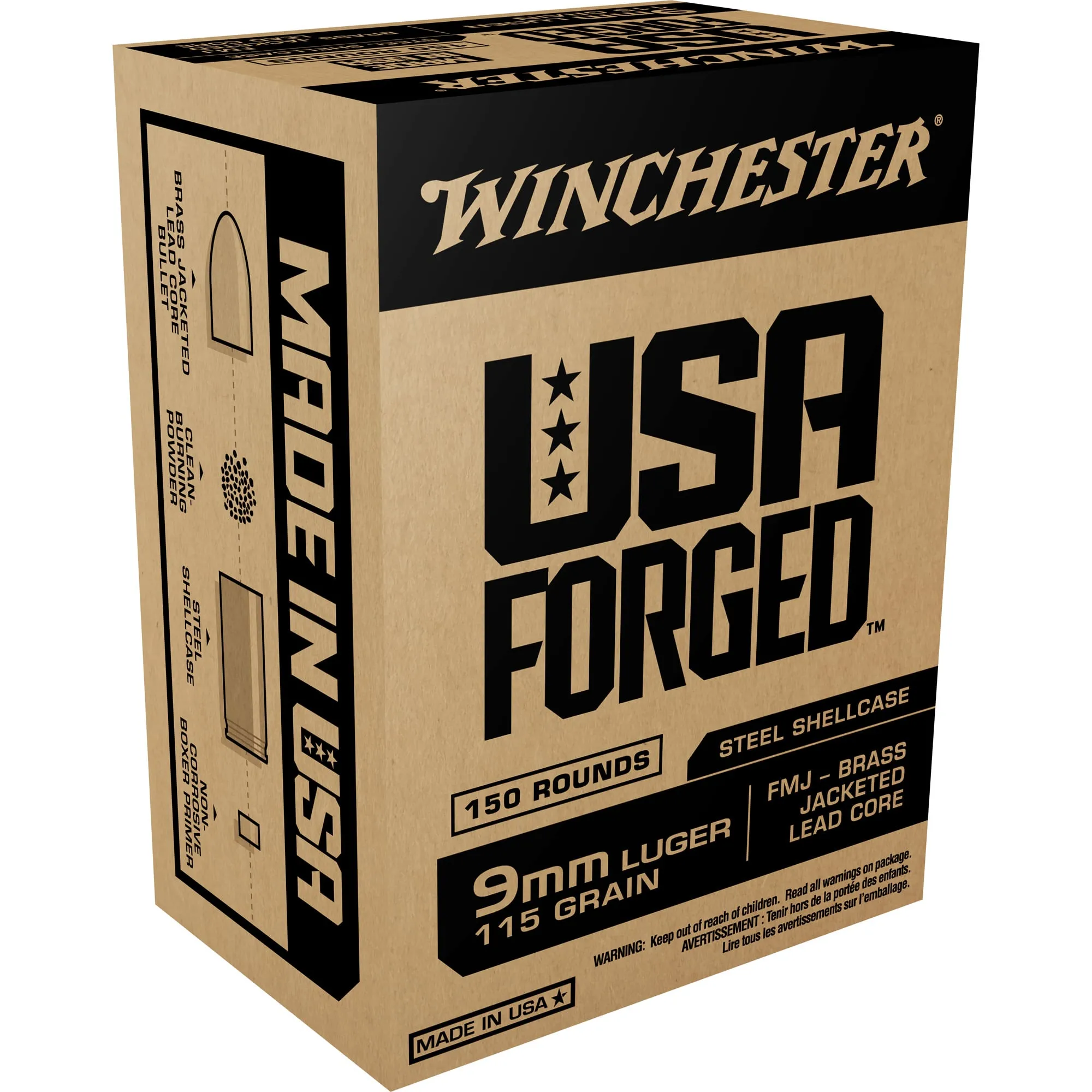
Winchester USA 9mm Ammunition, 1000 Rounds FMJ 115Gr - WIN9SK
9mm · 115gr · 1,000 rds

PMC Ammunition Bronze Brass 9mm 115-Grain 1000-Rounds Bulk FMJ
9mm · 115gr · 1,000 rds

PMC Ammunition Bronze Brass 9mm 124 Grain 1000-Rounds Bulk FMJ
9mm · 124gr · 1,000 rds

Winchester Centerfire Handgun Brass 9mm 115-Grain 1000-Rounds FMJ Bulk
9mm · 115gr · 1,000 rds
Cheapest .223 / 5.56 by the Case
Prices updated Oct 6, 2026
Wolf Military Classic Steel .223 Rem 55 Grain 500-Rounds Bulk FMJ
.223 Remington · 55gr · 500 rds

PMC Ammunition Bronze .223 Rem 55 Grain 1000-Rounds FMJ Bulk
.223 Remington · 55gr · 1,000 rds

Winchester M855 5.56 Bulk Ammo 62 Grain FMJ 1000rds (Unpainted Tip) - WM8551000
5.56x45mm NATO · 62gr · 1,000 rds

Wolf Performance Ammo PolyFormanc Steel Bulk .223 Rem 55 Grain 500-Rounds
.223 Remington · 55gr · 500 rds

Red Army Standard Centerfire Rifle Steel .223 Rem 55-Grain 500-Rounds Bulk FMJ
.223 Remington · 55gr · 500 rds

PMC Ammunition X-Tac Rifle Brass 5.56 55 Grain 1000-Rounds FMJBT Bulk
5.56x45mm NATO · 55gr · 1,000 rds
If you shoot enough to buy by the case, those two grids plus one alert per product is the entire system. The arithmetic on how much you actually need is in how many rounds it takes to get good, and if you are buying for a rifle you have not bought yet, how to buy a gun online covers the transfer side.
For load selection rather than price, our 9mm and 5.56 and .223 guides rank the loads themselves on the same live data.
What an Alert Will Not Do
Four honest limits.
It does not predict anything. An alert reports a change that already happened. We have no forecasting model and will not pretend to. If you want the structural reasons prices move, read why ammo prices move and when to buy hunting ammo, which shows the seasonal pattern in the data we have.
It does not include shipping. Every price we publish is the retailer's item price — not one of the 650,000-plus vendor records we store carries a shipping figure at all. A $3.00 median spread can vanish at checkout. On a case, it usually does not.
It does not know your state. Some jurisdictions restrict ammunition shipment, require an intermediary, or add permit steps. Ammo shipping restrictions explains how to check, and you should check before you chase a price across state lines.
It does not fix stock. A price drop on something out of stock is noise. We only count in-stock retailer listings for the lowest price, which filters most of that, but the window between an alert and a sell-out can be short on genuinely cheap bulk.
Set a Target, Not a Reminder
The mistake people make is setting a target a few cents below the current price. That triggers on noise.
Set it against the floor instead. Pull up the price index for your cartridge, take the market floor, work out what that implies for the pack size you actually want, and use that as your target. Cost per round explained covers why that normalization matters, and the ammo price index shows the current floors side by side. If a cartridge is brand new, expect wider swings — what actually happens when a new cartridge launches explains why its floor is unstable for the first couple of years.
Cost Per Round Calculator
The only number that matters when comparing ammo. Shipping included.
Run your target through that, set the alert, and stop checking. The whole point is that you do not have to.
Get alerted when 9mm price drops hit.
We watch every listing and email you the moment the cost per round drops.
Set Up a Free Price AlertAmmoSpotter earns a commission when you buy through links on this page. It never changes what you pay, and it never decides what we recommend — our picks are ranked on live cost-per-round data pulled from every retailer we track. Full disclosure.
Frequently Asked Questions
How does an ammo price alert work?+
Is it actually worth setting a price alert on ammunition?+
How often will I get emails?+
What target price should I set?+
Do your prices include shipping?+
Will an alert tell me when ammo prices are going to drop?+
Shop the data

About the author
AmmoSpotter Research Desk
Price & Ballistics Research
The AmmoSpotter Research Desk analyzes live retail pricing across every ammunition, firearm and accessory listing we track. Recommendations here are ranked against real cost-per-round data pulled daily from the retailers we monitor - not against manufacturer marketing copy.
- ✓Tracks 180,000+ live product listings across 6 retailer feeds
- ✓Records price history on every listing, every day
- ✓Cost-per-round methodology applied to all ammunition rankings
- ✓No product is ranked without a verifiable in-stock retail price
- ✓Affiliate relationships never influence rankings
Related Guides

AmmoSpotter Ammo Price Index: What Ammunition Costs Right Now
Most published ammunition pricing is one of two things: manufacturer MSRP, which nobody pays, or a hand-updated article that was accurate the week it was written. This page is neither. Every figure below is computed a...

Cost Per Round: The Only Ammo Price Metric That Matters
There is exactly one reason ammunition is hard to price-compare: it is advertised in boxes and consumed in rounds. Box counts are not standardized. A "box" of 9mm might be 50 rounds. A "value pack" might be 100, or 11...

Why Ammo Prices Move: The Five Forces Behind Every Spike
From the outside, ammunition pricing looks arbitrary. One cartridge climbs while another does not. A caliber that was plentiful in spring is thin by autumn. Prices rise fast and fall slowly. It is not arbitrary. Five ...

When to Buy Hunting Ammo: What Our Price Record Shows About the Season Curve
- We compared every hunting-caliber listing against itself between March and August 2026. Nearly all of them got more expensive. - Shotshells moved hardest: 12 gauge +8.57%, 20 gauge +7.94% over the window. - Deer rif...
Rimfire Price Index: What .22 LR Really Costs Now
.22 LR is still the cheapest way to put rounds through a gun. That part hasn't changed. What has changed is how wide the spread is inside the cartridge. A 50-round box of match ammunition and a 500-round brick of plin...
Shotgun Shell Price Index: Target, Buckshot and Slug Cost Per Shell
A box of shotgun shells can hold 5, 10, 15, 25, 100 or 250 shells, and the load inside can be a practice target shell or a premium turkey load. So the price on the box tells you almost nothing. The only useful compari...