M193 vs M855 Green Tip
Green tip is not an upgrade. It is a barrier round with a steel core that gets it banned from a lot of ranges - and it usually costs more. Here is when each one is the right buy.

The green tip looks like a premium tier. It is not. M855 is a specialized barrier round that trades close-range fragmentation and range access for the ability to punch through light steel — and it usually costs more to do it.
If you are buying practice ammunition, that trade is backwards.
The live price gap
Start here, because it decides the question for most buyers:
.223 / 5.56 NATO Price Index
Live · Oct 10, 2026M193-spec 55gr sits at the bottom of that range. M855 sits above it — the steel penetrator is an extra manufacturing step on a projectile that already ships in lower volume than the 55gr loading it was meant to supplement.
Across a thousand rounds, that is a real difference for ammunition you are going to shoot into a berm.
What each round actually is
M193 — 55gr lead-core FMJ
The original 5.56 loading. A 55-grain full metal jacket lead-core bullet driven fast. Its defining behavior is fragmentation: at close range and adequate velocity, the jacket tends to break at the cannelure and come apart.
It stabilizes in essentially any modern AR barrel, including 1:12 twists on older rifles.
M855 — 62gr with a steel penetrator
Adopted to improve performance against light barriers and to extend effective range. The projectile is longer and heavier, with a hardened steel penetrator seated over a lead core.
Two consequences follow from that construction, and both matter more than the ballistics:
- It needs faster twist. 1:7 is the military spec; 1:8 works well; 1:9 is marginal. A 1:12 barrel will not stabilize it.
- The steel core is magnetic, which is why ranges ban it.
Head to head
| M193 (55gr) | M855 (62gr green tip) | |
|---|---|---|
| Projectile | Lead-core FMJ | Steel penetrator over lead core |
| Velocity | Higher | Lower |
| Twist needed | 1:12 and faster | 1:8 or faster |
| Close-range fragmentation | More readily | Less predictably |
| Light barrier performance | Weaker | Stronger |
| Range acceptance | Universal | Frequently banned |
| Steel target safe | Generally yes | No |
| Typical cost per round | Lower | Higher |
| Best for | Volume practice, general use | Barrier-specific requirements |
So which should you buy?
Volume practice: M193. Cheaper, universally range-legal, stabilizes in anything, and fragments better at the distances you actually shoot. There is no practical reason to pay more for green tip to make holes in paper.
Cheapest 5.56 / .223 Practice Ammo Right Now
Prices updated Oct 10, 2026
RED ARMY STANDARD 223 Remington 56Gr FMJ Steel Case 20rd
.223 Remington · 56gr · 20 rds

BARNES AMMO 223 Cal Varmint Grenade FB 50Gr 100rd
.223 Remington · 50gr · 100 rds

BARNAUL AMMO 223 Rem 55Gr HPBT Polycoated Steel Case 20rd
.223 Remington · 55gr · 20 rds

BARNAUL AMMO 223 Rem 62Gr SPBT Polycoated Steel Case 20rd
.223 Remington · 62gr · 20 rds

BARNAUL AMMO 223/5.56 62Gr FMJBT Steel Case 20rd
.223 Remington · 62gr · 20 rds
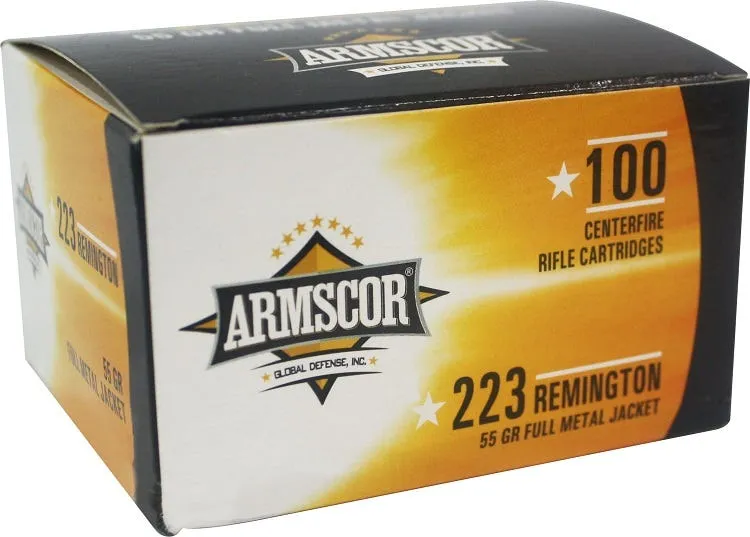
Armscor Rifle Ammo Brass .223 Rem 55-Grain 100-Rounds FMJ
.223 Remington · 55gr · 100 rds
Bulk stockpiling: M193, with one caveat. If you are buying a case, M193 is the better value and the more flexible round. The caveat is twist rate — if you own a 1:7 or 1:8 rifle and expect to shoot heavier projectiles later, keep some budget for those instead of putting everything into 55gr.
Bulk 5.56 / .223 - 500 Rounds and Up
Prices updated Oct 10, 2026
Wolf Military Classic Steel .223 Rem 55 Grain 500-Rounds Bulk FMJ
.223 Remington · 55gr · 500 rds

PMC Ammunition Bronze .223 Rem 55 Grain 1000-Rounds FMJ Bulk
.223 Remington · 55gr · 1,000 rds

Winchester M855 5.56 Bulk Ammo 62 Grain FMJ 1000rds (Unpainted Tip) - WM8551000
5.56x45mm NATO · 62gr · 1,000 rds

Red Army Standard Centerfire Rifle Steel .223 Rem 55-Grain 500-Rounds Bulk FMJ
.223 Remington · 55gr · 500 rds

PMC Ammunition X-Tac Rifle Brass 5.56 55 Grain 1000-Rounds FMJBT Bulk
5.56x45mm NATO · 55gr · 1,000 rds

Wolf Performance Ammo PolyFormanc Steel Bulk .223 Rem 55 Grain 500-Rounds
.223 Remington · 55gr · 500 rds
Home defense: neither. Both are military ball designed to penetrate. M855's steel core makes it the worse of the two inside a house. You want a bonded soft point or a controlled-expansion load that dumps energy fast. See our best 5.56 and .223 ammo guide for what to look for.
Barrier penetration specifically: M855. If you have an actual requirement to defeat light steel, that is what the round was designed for, and it does the job M193 does not. That is a narrow requirement, and it is the only one that justifies the premium.
The twist rate question, briefly
This is the spec that decides whether M855 is even an option for you.
| Barrel twist | M193 (55gr) | M855 (62gr) | Heavy match (77gr) |
|---|---|---|---|
| 1:12 | Yes | No | No |
| 1:9 | Yes | Marginal | No |
| 1:8 | Yes | Yes | Yes |
| 1:7 | Yes | Yes | Yes |
Check the roll mark on your barrel before buying anything heavier than 55gr. The full breakdown, including match bullet selection, is in best 5.56 and .223 ammo.
One more variable: case material
If cost per round is what brought you here, case material is a larger lever than the M193-versus-M855 choice. Steel-cased 5.56 is meaningfully cheaper than brass — and carries its own set of trade-offs, including the same range-access problem that dogs M855.
We laid out the honest version in steel case vs brass case ammo.
Buy on the number, not the tip color
Whatever you conclude here, the buying process does not change: convert every listing to landed cost per round, compare against the current market floor, and set an alert instead of refreshing retailer pages.
Cost Per Round Calculator
The only number that matters when comparing ammo. Shipping included.
Get alerted when .223 Remington price drops hit.
We watch every listing and email you the moment the cost per round drops.
Set Up a Free Price Alert- Every .223 / 5.56 listing by cost per round
- Best 5.56 and .223 ammo
- .223 vs 5.56: the difference that matters
- AmmoSpotter Ammo Price Index
AmmoSpotter earns a commission when you buy through links on this page. It never changes what you pay, and it never decides what we recommend — our picks are ranked on live cost-per-round data pulled from every retailer we track. Full disclosure.
Frequently Asked Questions
Is M855 green tip armor piercing?+
Is M855 more accurate than M193?+
Which is better for home defense, M193 or M855?+
Do I need a 1:7 twist barrel for M855?+
Why is M855 usually more expensive than M193?+

About the author
AmmoSpotter Research Desk
Price & Ballistics Research
The AmmoSpotter Research Desk analyzes live retail pricing across every ammunition, firearm and accessory listing we track. Recommendations here are ranked against real cost-per-round data pulled daily from the retailers we monitor - not against manufacturer marketing copy.
- ✓Tracks 180,000+ live product listings across 6 retailer feeds
- ✓Records price history on every listing, every day
- ✓Cost-per-round methodology applied to all ammunition rankings
- ✓No product is ranked without a verifiable in-stock retail price
- ✓Affiliate relationships never influence rankings
Related Guides

Best 5.56 & .223 Ammo 2026: Practice, Defense and Precision
5.56x45mm NATO and .223 Remington are the most-purchased rifle cartridges in America, and the most confusing to buy. The same rifle will accept ammunition ranging from bulk steel-cased plinking loads to match ammuniti...

.223 vs 5.56: The Difference That Actually Matters
The cases are dimensionally near-identical. The ammunition will chamber in either rifle. That is exactly why this matters — nothing physically stops you from making the mistake. The two real differences 1. Pressure 5....

Steel Case vs Brass Case Ammo: What You Actually Give Up
Steel-cased ammunition occupies a strange place in shooting culture: universally used, frequently condemned, rarely analyzed. The honest position is narrower than either camp claims. Steel is cheaper. It is cheaper fo...

AmmoSpotter Ammo Price Index: What Ammunition Costs Right Now
Most published ammunition pricing is one of two things: manufacturer MSRP, which nobody pays, or a hand-updated article that was accurate the week it was written. This page is neither. Every figure below is computed a...
Ammo Grain Weight Explained: What Bullet Weight Actually Changes
- A grain is a unit of mass — 7,000 to the pound . It describes the bullet only, and it is a specification, not a quality rating. - You are not paying for lead. Within 9mm alone, cost per grain of bullet varies more t...

Best 5.56 Ammo for Home Defense: Why FMJ Is the Wrong Default
Most home-defense ARs in this country are loaded with whatever was cheapest at the last range trip. That is usually 55 grain M193 or 62 grain green tip, and both of them are military ball designed to punch through thi...