Suppressor Buying Guide
The can is the cheap part. Here is the full cost of going suppressed, including the ammo bill nobody budgets for.

What does a suppressor actually cost?
The sticker price is the part everyone anchors on, and it is the part that moves. We currently carry 1,972 listings under the silencer product type, tracked across multiple retailers with full price history, which means the spread between the cheapest and most expensive place to buy the exact same can is visible rather than assumed.
Here is the current market, sorted by how many of our tracked retailers are actively stocking each one:
Suppressors In Stock Across Our Retailers
Prices updated Oct 21, 2026
Q El Camino Rimfire Suppressor .22LR 5.95-inch

Rugged Suppressors Mustang 22 .22 LR 1/2x28 Direct Thread Mount
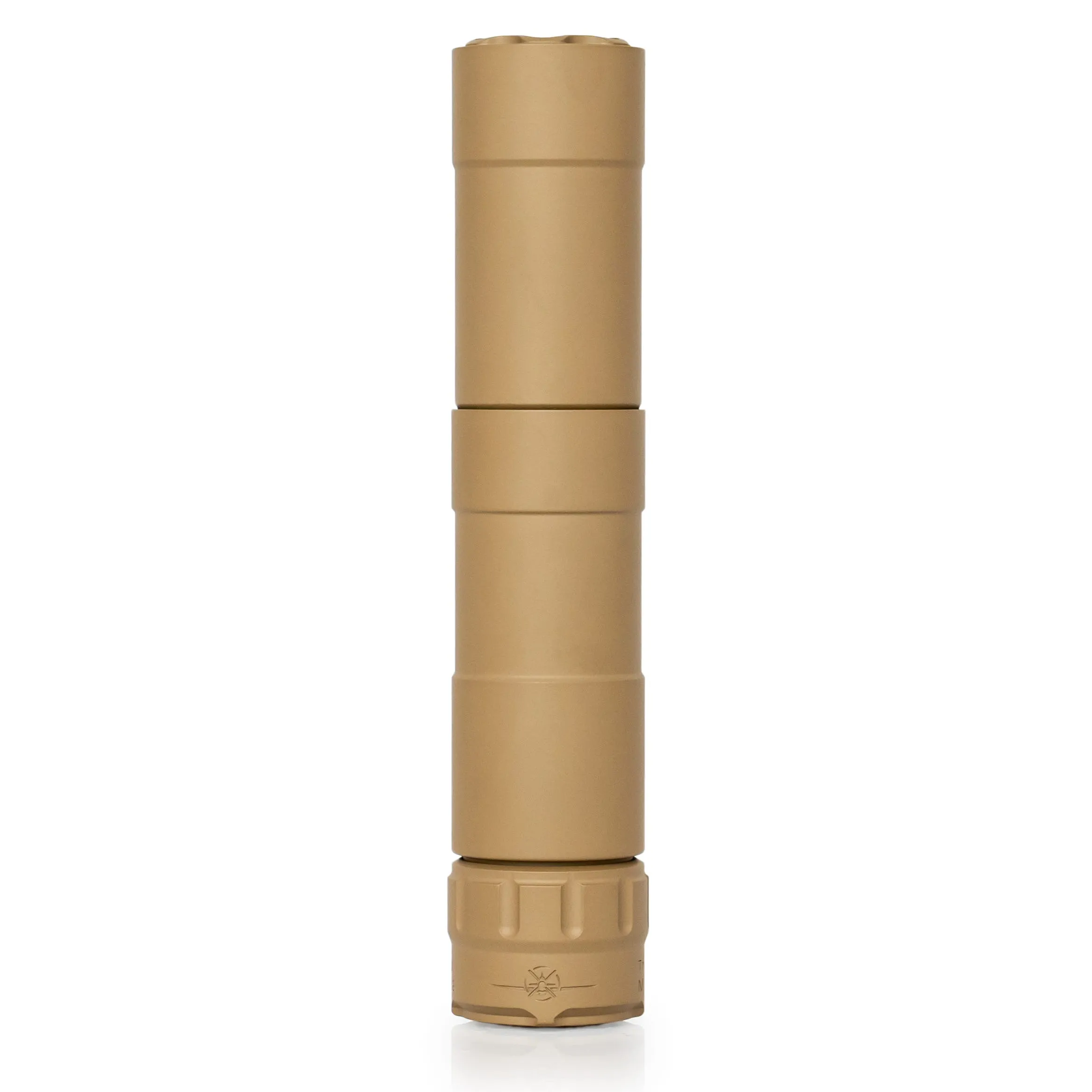
Rugged Suppressors Mustang 22 Flat Dark Earth .22 LR Modular

HUXWRX Flow 22 Ti Flat Dark Earth .22 LR 1/2x28

HUXWRX Flow 22 Ti .22 1/2x28 Direct Thread

Rugged Suppressors Oculus 22 .22 LR / 5.7 X 28 1/2x28 Thread

Rugged Suppressors Oculus 22 Flat Dark Earth .22 LR

Dead Air Armament Mask-22 Flat Dark Earth .22 LR 1/2x28

Dead Air Armament Mask-22 Stainless .22 LR
What that grid does not show you is the rest of the bill. A suppressor purchase is four line items:
- The can. Live above.
- The federal transfer. A registered transfer, a background check, and a wait. There is a transfer tax attached to it whose amount has been the subject of recent legislative change — do not take a figure from any article, including this one. Ask the dealer who is holding your can what you will owe today.
- The dealer's fee. Separate from the tax. It varies by shop and is negotiable more often than people assume.
- The mount. Some cans ship with a muzzle device. Many do not, and a quick-detach mount is not a small purchase. Check the product listing before you assume it is included.
Which suppressor should you buy first?
The honest answer is that it depends on what is in your safe right now, and the second most honest answer is that most people buy the wrong one first because they buy aspirationally.
The two defensible starting points:
A rimfire can, if you own a .22 pistol or rifle. It is the cheapest entry into the category and it gets used, because .22 LR is the cheapest ammunition on the market by a wide margin. A rimfire can plus a bulk brick is the lowest cost-per-trigger-pull suppressed shooting there is. Our .22 LR ammo guide covers what the bulk tier actually costs right now.
A .30-caliber centerfire can, if you own multiple rifles. The bore is large enough to run everything from 5.56 up through .308, which means one transfer instead of three. You give up some performance on the smaller cartridges versus a dedicated 5.56 can. Most people find that trade worth it once they price out a second wait.
The case against buying a caliber-specific can first is not that the caliber-specific can is worse. It is better, at its one job. The case against it is that every additional can is another transfer, another fee, and another wait, and you will not know what you actually want until you have shot suppressed for a season.
Where to Start, by Host
Q El Camino .22 LR
A short, light, direct-thread rimfire can. Rimfire suppressors get filthy and have to come apart, and this one is built to be taken down without a fight.
Pros
- ✓Fully user-serviceable
- ✓Light enough it does not change how a 10/22 handles
- ✓Cheapest entry point among the cans we track from multiple retailers
Cons
- ✗Direct thread only
- ✗Rimfire only, so it is a second purchase not a do-everything can
Rugged Suppressors Oculus 22
Rated past .22 LR to 5.7x28, which matters if a rimfire can is going to live on more than one gun.
Pros
- ✓Covers 5.7x28 in addition to rimfire
- ✓Takes down for cleaning
Cons
- ✗Costs more than a rimfire-only can
- ✗Still not a centerfire rifle suppressor

Rugged Suppressors Obsidian 9
Pistol-caliber and .300 Blackout in one housing. If you own a 9mm handgun, a PCC and a Blackout upper, this is the one stamp that covers all three.
Pros
- ✓Modular length
- ✓Covers 9mm and .300 BLK on a single tax stamp
- ✓Piston and direct-thread mounting options
Cons
- ✗Heavier than a dedicated 9mm can
- ✗Piston mounts need maintenance most rifle cans do not

Griffin Armament Recce 5
A 5.56-rated can that ships with its own muzzle device, so you are not buying the mount separately after the fact.
Pros
- ✓Brake included, not a separate line item
- ✓Purpose-built for 5.56 pressure and heat
Cons
- ✗Caliber-limited compared with a .30-cal can
- ✗Quick-detach mounts add length over direct thread

YHM Resonator .30 Cal
A .30-caliber-bore can runs everything from 5.56 up to .308, at the cost of some performance on the small stuff.
Pros
- ✓One can covers most of a rifle safe
- ✓Full-auto and short-barrel rated in this class
Cons
- ✗Larger bore is a compromise on 5.56
- ✗Heavier on the muzzle than a caliber-specific can
Is a rimfire suppressor a different purchase than a centerfire one?
Yes, and the difference is maintenance.
.22 LR is filthy. Unjacketed lead, soft, and thrown at low pressure, it deposits lead and carbon inside a can at a rate no centerfire cartridge approaches. A rimfire suppressor that cannot be disassembled will eventually weld itself shut. This is why serviceable construction is the first thing to check on a rimfire can and effectively irrelevant on a centerfire one — modern centerfire cans are sealed, fully welded units, and that is correct for how they are used.
The second difference is that rimfire cans are cheap enough to be an impulse purchase and centerfire cans generally are not. That cuts both ways. It is a low-risk way to find out whether suppressed shooting is something you will actually do. It is also how people end up with a rimfire can and a .30-cal can and no clear plan.
Direct thread or quick-detach?
Direct thread is shorter, lighter, cheaper, and repeatable. It threads onto the barrel and that is the whole system. The cost is time: swapping between hosts means unthreading a hot can.
Quick-detach requires a muzzle device on every host you want to run, and each of those devices is a purchase. It adds length ahead of the muzzle and it adds a mechanical interface that can loosen. What it buys you is fast host swaps and, on brake-style mounts, some recoil reduction when the can is off.
The rule that holds up: one host, direct thread. Several hosts, quick-detach. If the can lives on one rifle permanently, you are paying for a feature you will use twice a year.
What are you paying for in the materials?
Three materials cover almost everything on the market.
- Aluminum — light, cheap, low heat tolerance. Fine for rimfire and pistol calibers. Not for rifle rates of fire.
- Stainless steel — durable, heavy, inexpensive relative to the alternatives. The default for centerfire cans where weight is not the priority.
- Titanium — much lighter than stainless at similar strength, considerably more expensive. This is where most of the price spread in the .30-cal market comes from.
- Inconel and other high-temp superalloys — used in the blast baffle of hard-use cans rated for sustained fire. You pay for it, and if you are not shooting at machine-gun rates you will not notice.
Weight on the muzzle is the thing buyers underestimate. A heavy can on a light rifle changes the balance enough to matter offhand. That is the actual reason to pay for titanium, not the spec sheet.
The recurring cost: subsonic ammunition
This is the part that gets left out of every buying guide, and it is the part that determines whether the can gets used.
A suppressor reduces muzzle blast. It does nothing about a bullet going faster than the speed of sound — that crack happens downrange and no can touches it. On a 9mm pistol or a .22 rifle, most factory ammunition is already subsonic, so the can does its job unassisted. On a centerfire rifle, quiet requires purpose-built subsonic loads, and those are a different market with different pricing.
Here is what the three most common suppressed hosts cost to feed right now:
.22 LR Price Index
Live · Oct 21, 20269mm Luger Price Index
Live · Oct 21, 2026.300 Blackout Price Index
Live · Oct 21, 2026The gap between those three is the whole argument. .300 Blackout exists in large part to be shot suppressed and subsonic, and it is priced accordingly against high-volume cartridges. If you are considering a Blackout upper specifically for suppressed use, price the ammunition before the can — the ammunition is the larger lifetime cost, and our 5.56 vs .300 Blackout comparison runs that trade-off in detail. The full live .300 Blackout catalog is worth scanning before you commit to the platform, and the .22 LR catalog shows what the alternative costs.
Cheapest .300 Blackout Per Round
Prices updated Oct 21, 2026
Wolf Performance Ammo Polyformance Steel Case .300 AAC Blackout 145 Grain 20-Rounds
.300 Blackout · 145gr · 20 rds

NOSLER Custom Brass 300 AAC Blackout Bulk Brass 250rd
.300 Blackout · 250 rds

MAGTECH 300 AAC Blackout HPFB 115Gr 50rd
.300 Blackout · 115gr · 50 rds

SELLIER BELLOT SB300BLKB 300 AAC Blackout 147gr Full Metal Jacket Ammunition | 20 Rounds
.300 Blackout · 147gr · 20 rds

ARMSCOR Precision 300 AAC Blackout 147gr Full Metal Jacket Ammunition | 100 Rounds
.300 Blackout · 147gr · 100 rds

SELLIER BELLOT SB300BLKSUBA 300 AAC Blackout 200gr Full Metal Jacket Subsonic Ammunition | 20 Rounds
.300 Blackout · 200gr · 20 rds
Work out your own annual number rather than guessing at it:
Cost Per Round Calculator
The only number that matters when comparing ammo. Shipping included.
If the answer surprises you, that is useful information before the transfer, not after. Our guide on how many rounds it takes to get good is a reasonable starting estimate for volume, and why ammo prices move covers why the subsonic tier does not track the bulk market. Shooters who already reload should read whether reloading is still cheaper first — subsonic rifle loads are one of the few places where the answer is still clearly yes.
What to check before you put money down
- Is it in stock at more than one retailer? Single-source listings are where the price spread is worst. The grids above sort by retailer coverage for exactly this reason.
- Does it include a mount? If the listing does not say so explicitly, assume it does not.
- Is the thread pitch right for your host? 1/2x28 for most .22 and 5.56, 5/8x24 for most .30-caliber. Confirm against your actual barrel.
- Is the can rated for the host? Barrel length minimums and full-auto ratings are real limits, not suggestions.
- Can the dealer tell you what transfers have been taking recently? If they will not give you a straight answer on their own recent customers, that tells you something.
One more practical note: the can and the ammunition do not have to be bought in the same month. The transfer wait is dead time. Shooters who use it to build up an ammunition stock at good prices show up on range day ready to actually use the thing. What ammunition to stack is covered in what to shoot suppressed, and if you are shipping ammunition across state lines to get there, check the shipping restrictions first.
Get alerted when .300 Blackout price drops hit.
We watch every listing and email you the moment the cost per round drops.
Set Up a Free Price AlertAmmoSpotter earns a commission when you buy through links on this page. It never changes what you pay, and it never decides what we recommend — our picks are ranked on live cost-per-round data pulled from every retailer we track. Full disclosure.
Frequently Asked Questions
How much does a suppressor cost in total?+
What is the best first suppressor to buy?+
Do I need subsonic ammo to use a suppressor?+
How long does a suppressor transfer take?+
Are suppressors legal in my state?+
Does a suppressor wear out?+

About the author
AmmoSpotter Research Desk
Price & Ballistics Research
The AmmoSpotter Research Desk analyzes live retail pricing across every ammunition, firearm and accessory listing we track. Recommendations here are ranked against real cost-per-round data pulled daily from the retailers we monitor - not against manufacturer marketing copy.
- ✓Tracks 180,000+ live product listings across 6 retailer feeds
- ✓Records price history on every listing, every day
- ✓Cost-per-round methodology applied to all ammunition rankings
- ✓No product is ranked without a verifiable in-stock retail price
- ✓Affiliate relationships never influence rankings
Related Guides

Best Ammo for Suppressed Shooting: Subsonic, Supersonic and What Actually Goes Quiet
The most common disappointment with a first suppressor is that it did not make the rifle quiet. The can is usually fine. The ammunition is usually the problem. A gunshot makes three distinct noises, and a suppressor o...

5.56 vs .300 Blackout: Which One Is Actually Worth Feeding?
- .300 Blackout costs materially more per round than 5.56, every day, in every brand we track. That gap is structural, not a temporary spike. - Both cartridges run in the same lower, the same bolt carrier group and th...

Best .22 LR Ammo 2026: Bulk, Match and Hunting on Live Prices
- .22 LR is the cheapest trigger time available, and it is not close. The live floor below is roughly what a single centerfire rifle round costs in loose change. - Bulk barely helps. Across our catalog the 50-round bo...

How AmmoSpotter Ranks Ammunition (And What We Refuse to Claim)
Most ammunition rankings on the internet are one of two things: a static list assembled once and never revisited, or an affiliate page ordered by commission rate. Neither tells you what to buy today. This page is our ...
Suppressor Mounts Explained: Direct Thread vs QD vs HUB, Priced
- Mount hardware is the cheapest part of a suppressor purchase. The whole suppressor-accessory shelf we track has a median under $80, and its cheapest tier is shims and O-rings, not mounts. - The mount choice shows up...
Best Shooting Ear Protection 2026: What Our Price Data Says About NRR
- We track 487 live ear protection listings , from $1.89 to $839.99, median $27.39 . - Among listings that state an attenuation figure, passive models average 25.9 dB and electronic models average 23.4 dB — while the ...