9mm Price History: What a Round Actually Costs
We have logged every price change on every 9mm listing we track since February 2026. Here is what that record shows, what it cannot show, and how to use it when you buy.

Most "ammo price history" pages are a memory exercise. Someone recalls paying nineteen cents a round before 2020, quotes it as fact, and builds an argument on top of it.
We took a different approach: log every price change on every listing we track, and keep the receipts. Since mid-February 2026 that record has grown to just under nine million individual price observations across the catalog. This page is what the 9mm portion of it says.
What does 9mm cost right now?
Start here, because every other section on this page is context for this block.
9mm Luger Price Index
Live · Oct 21, 2026Four numbers, generated when you loaded the page. The market floor is the realistic bottom for a round of 9mm across the retailers we track. The market average is what the whole catalog averages, defensive and match ammunition included. The lowest box price is the smallest total ticket available. And the 30-day figure is the direction the listings we already track have moved.
At the time this article was written, the snapshot behind that block covered 675 approved 9mm listings, with a market floor near 24 cents per round, a catalog average of about 74 cents, and a lowest box price of $9.99. If the block above disagrees with those figures, the block is right — it re-queries on every page load, and this paragraph does not.
Why is the average 9mm price triple the floor?
That gap is the single most misread number in ammunition pricing, and it is not evidence of anything being wrong.
9mm covers products with almost nothing in common except a case head. Bulk 115-grain full metal jacket exists to be shot in volume at paper. Bonded defensive hollow points exist to pass a specific terminal-performance protocol, and they are manufactured, tested and lot-controlled accordingly. Specialty hard-cast and heavy-for-caliber loads exist for a narrow set of buyers who are not price shopping at all.
In our snapshot the highest tracked cost per round in 9mm was $3.740, against a floor of $0.240. Averaging across that range produces a number that describes no actual shopper. It is a real statistic about the catalog and a bad guide to your purchase.
The practical rule: compare within a category. If you are buying practice ammunition, the floor is your benchmark. If you are buying carry ammunition, the floor is irrelevant and you should be reading best 9mm ammo instead, which separates the loads by job.
How do you build a price history that isn't lying to you?
This is the part that separates a real dataset from a chart.
The naive method is to average the price of every 9mm listing this week, average every listing last month, and report the difference. It looks rigorous and it is close to meaningless. In any given week the mix of what repriced changes: a week where several thousand-round cases moved will average out completely differently from a week where fifty-round boxes moved, and the "trend" you produce is a sampling artifact rather than a price signal. We saw swings above fifty percent from that method alone.
So the trend figure in our index uses matched pairs. Each individual listing is compared against itself across the two windows, and only listings observed in both periods count toward the result. If fewer than eight paired observations exist for a cartridge, we show nothing rather than dress up noise as a finding.
That is also why the number is usually modest. Honest price movement in a stable market is measured in single-digit percentages. Anything dramatic is either a real event or a broken method, and most of the dramatic numbers you will read elsewhere are the second one.
Our full methodology, including what we refuse to claim, is written up in how we rank ammunition.
Which brands actually sit at the bottom of the 9mm market?
Brand matters less than packaging at the low end, but it is not noise either. From the snapshot behind this article, the lowest tracked cost per round by brand looked like this:
| Brand | Listings tracked | Lowest cost per round |
|---|---|---|
| Winchester | 60 | $0.220 |
| Magtech | 20 | $0.220 |
| Ammo Inc | 18 | $0.258 |
| Blazer Ammo | 17 | $0.260 |
| CCI | 20 | $0.264 |
| Federal | 72 | $0.280 |
| Remington | 49 | $0.283 |
| Fiocchi | 20 | $0.306 |
| Speer | 33 | $0.382 |
| Sig Sauer | 32 | $0.458 |
| Hornady | 24 | $0.700 |
| Buffalo Bore | 25 | $1.300 |
Read the second column alongside the third. Federal carries the most tracked 9mm listings of any brand in our catalog but does not hold the floor, because its lineup is weighted toward defensive and premium product. Buffalo Bore's $1.300 low is not a failure to compete on price; it is a catalog that contains no budget ammunition at all.
The names at the bottom are consistently the steel-case and aluminum-case range loads — Winchester USA Forged, Magtech steel, Blazer aluminum. That is a real and durable finding across our record. Whether steel and aluminum cases suit you is a separate question with real trade-offs, covered in steel case vs brass ammo.
Where the cheapest 9mm is right now
The floor moves between listings constantly. Rather than name a winner that will be wrong by next week, here is the live grid, sorted by cost per round:
Cheapest Tracked 9mm by Cost per Round
Prices updated Oct 21, 2026
MAGTECH 9mm Luger Steel Case 124 FMJ 50rd
9mm · 50 rds

SELLIER BELLOT 9mm 115gr FMJ Brass Ammunition | 50 Rounds
9mm · 115gr · 50 rds
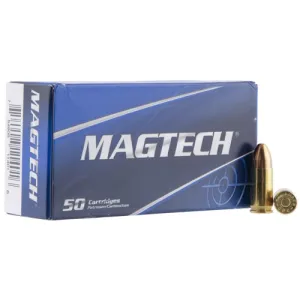
MAGTECH 9mm 115gr Full Metal Jacket Brass Ammunition | 50 Rounds
9mm · 115gr · 50 rds

SELLIER BELLOT 9mm 124Gr 1200 FPS FMJ 50rd
9mm · 124gr · 50 rds
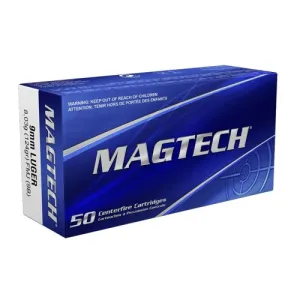
MAGTECH 9mm 124gr FMJ 50rd
9mm · 124gr · 50 rds

MILI CUSTOM DEFENSE AMMUNITION 9mm 155gr Subsonic FMJ 50rd
9mm · 155gr · 50 rds
One pattern in that grid holds up across effectively our entire record: the lowest per-round prices cluster on case quantities. A thousand-round case spreads one shipping charge and one box across a thousand rounds, and 50-round boxes cannot compete with that on arithmetic alone. The exception is a genuine loss-leader box promotion, which is real but small and rarely restocks.
If you want to check that arithmetic against a specific listing including shipping:
Cost Per Round Calculator
The only number that matters when comparing ammo. Shipping included.
What can this record actually tell you — and what can't it?
Be clear about the boundaries, because they are the reason to trust the rest.
It can tell you what 9mm costs across the retail market today, which listings sit at the floor, how far a given asking price is from that floor, and which direction tracked listings have moved over the last month. Those are all direct readings from logged observations.
It cannot tell you what 9mm cost in 2013 or 2020. Our observation record begins in February 2026. We could find those figures in secondary sources and repeat them, and we are not going to, because a number we did not observe is a number we cannot stand behind.
It cannot tell you what happens next. Nothing in a price series predicts a demand shock, and demand shocks are the dominant force in this market. The five things that actually move ammunition prices — and the reason the calendar is not one of them — are laid out in why ammo prices move. The related question of whether there is a cheap season is answered, unsatisfyingly but accurately, in when is the cheapest time of year to buy ammo.
It cannot tell you whether a cartridge is worth adopting. New chamberings launch expensive and thin, for structural reasons that have nothing to do with performance; that dynamic is its own piece, what actually happens when a new cartridge launches.
How should price history change what you do?
Three concrete uses. Everything else is entertainment.
Set a buy trigger, not a buy date. Decide the cost per round at which you will buy a case, based on the floor rather than a remembered price, and act when the market reaches it. This is strictly better than waiting for a month, because the trigger is a number you can verify and a month is a superstition.
Size the purchase against your actual round count. A twelve-cent difference per round is $120 across a thousand rounds and $6 across fifty. Whether that gap is worth chasing depends entirely on how much you shoot, which most people overestimate — how many rounds does it take to get good puts realistic numbers on that.
Know your alternative. For high-volume handgun shooters, loading your own is the obvious lever, and whether it still pays at the current floor is arithmetic rather than opinion. We ran it in is reloading still cheaper than buying ammo. The short version is that the answer depends on what the floor is doing, which is exactly why the floor is worth watching.
The same logic applies to rifle calibers, where the spread is wider and the floor moves harder — see best 5.56 and .223 ammo for that market.
Watch the number instead of remembering it
The point of keeping a price record is not to produce a chart. It is to replace a remembered price with a current one, so that "that seems expensive" becomes a claim you can check in five seconds.
Every tracked listing, sorted by cost per round, lives on the 9mm caliber page. The same read across every cartridge we follow is on the ammo price index, and the full catalog is at all tracked ammunition.
If you would rather not check manually, set a target and let the floor come to you:
Get alerted when 9mm price drops hit.
We watch every listing and email you the moment the cost per round drops.
Set Up a Free Price AlertAmmoSpotter earns a commission when you buy through links on this page. It never changes what you pay, and it never decides what we recommend — our picks are ranked on live cost-per-round data pulled from every retailer we track. Full disclosure.
Frequently Asked Questions
How much has 9mm ammo cost historically?+
How far back does AmmoSpotter's 9mm price history go?+
Why is the average 9mm price so much higher than the cheapest?+
Does a lower price per round always mean a better buy?+
Is the 30-day trend a prediction?+
What is the cheapest way to buy 9mm right now?+
Shop the data

About the author
AmmoSpotter Research Desk
Price & Ballistics Research
The AmmoSpotter Research Desk analyzes live retail pricing across every ammunition, firearm and accessory listing we track. Recommendations here are ranked against real cost-per-round data pulled daily from the retailers we monitor - not against manufacturer marketing copy.
- ✓Tracks 180,000+ live product listings across 6 retailer feeds
- ✓Records price history on every listing, every day
- ✓Cost-per-round methodology applied to all ammunition rankings
- ✓No product is ranked without a verifiable in-stock retail price
- ✓Affiliate relationships never influence rankings
Related Guides

AmmoSpotter Ammo Price Index: What Ammunition Costs Right Now
Most published ammunition pricing is one of two things: manufacturer MSRP, which nobody pays, or a hand-updated article that was accurate the week it was written. This page is neither. Every figure below is computed a...

Cost Per Round: The Only Ammo Price Metric That Matters
There is exactly one reason ammunition is hard to price-compare: it is advertised in boxes and consumed in rounds. Box counts are not standardized. A "box" of 9mm might be 50 rounds. A "value pack" might be 100, or 11...

Why Ammo Prices Move: The Five Forces Behind Every Spike
From the outside, ammunition pricing looks arbitrary. One cartridge climbs while another does not. A caliber that was plentiful in spring is thin by autumn. Prices rise fast and fall slowly. It is not arbitrary. Five ...

When Is the Cheapest Time of Year to Buy Ammo? (2026)
The question assumes ammunition behaves like patio furniture — that there is a predictable end-of-season dip, and that a patient buyer beats an impatient one by waiting for it. It does not work that way. The forces th...

What Is Driving Ammo Prices Right Now: A Live Read of the Market
- There is no single "ammo price." There is a floor, an average and a trend, and they differ per cartridge — the blocks below are live, not typed in. - Market-wide averages hide the thing you care about. Dispersion be...

5.56 Price History and Where It Is Heading
Half of the search that brought you here is answerable and half of it is not. What 5.56 costs, across every retailer we track, normalized to cost per round, with a logged record behind it — that we can do precisely. W...