5.56 Price History: What the Record Shows
What 5.56 NATO costs across every listing we track, why it prices well above 9mm, and an honest answer to the part of the question nobody can actually answer.

Half of the search that brought you here is answerable and half of it is not.
What 5.56 costs, across every retailer we track, normalized to cost per round, with a logged record behind it — that we can do precisely. Where it is heading is a different kind of question, and the honest answer is short enough to fit in a sentence. We will get to it.
What does 5.56 cost right now?
Everything below is context for this block. It is generated when the page loads, from listings we currently track.
5.56 NATO Price Index
Live · Oct 21, 2026At the time of writing, the snapshot behind that block covered 122 approved 5.56 NATO listings, with a market floor near 50 cents per round, a catalog average near 81 cents, a lowest box price of $9.99 and a most-expensive tracked round at $2.300. If the live block disagrees, trust the block — it re-queries continuously and this paragraph does not.
Two things about that spread are worth saying out loud. The average sits well above the floor because the catalog includes match, barrier-blind and monolithic hunting loads alongside bulk M193-spec practice ammunition. And the floor is not the single cheapest listing in the database; it is the third-cheapest qualifying one, which is why a brand in the table further down shows a low beneath the published floor.
Why is 5.56 nearly double the price of 9mm?
This is the most common complaint about rifle ammunition and it has a boring, structural answer.
A 5.56 case is substantially larger than a 9mm case and holds roughly three to four times the powder charge. Brass and propellant are the two commodity inputs whose costs dominate cartridge pricing, and a rifle round simply contains more of both. The bullet is lighter, which helps at the margin, but not enough to close the gap.
The numbers bear it out. Against the 5.56 floor of roughly $0.500 per round in this snapshot, the equivalent 9mm floor in our tracked data sat near $0.240. That ratio has been stable across our record, and it is the single most useful thing to know before planning a training year: a thousand rounds of rifle practice costs about what two thousand rounds of pistol practice costs.
It is also why the round-count question matters more for rifle shooters. If you have not put a real number on how much you actually shoot, how many rounds does it take to get good is worth reading before you plan a bulk purchase around a price you have not verified.
Should you be shopping .223 or 5.56?
They are close enough that most buyers treat them as one market and different enough that treating them as one market can hurt you.
We track them as separate cartridges, because they are separate specifications with different pressure standards and different chamber geometry. As a general rule, a rifle chambered in 5.56 NATO or .223 Wylde will safely handle both, while a rifle chambered strictly in .223 Remington should be fed .223. Check the barrel marking on your own rifle rather than assuming — this is the one place in this article where getting it wrong has consequences beyond your wallet. The full technical comparison is in .223 vs 5.56.
If your rifle takes either, then both markets are yours, and you should shop both. Here is the combined view across the cartridges together:
.223 / 5.56 Combined Price Index
Live · Oct 21, 2026The two indexes rarely agree, because supply arrives in lots and a lot of one specification landing at a big retailer moves that cartridge's floor and not the other's. Buyers who only ever check one of the two are leaving the cheaper half of the market unseen roughly half the time.
The related question — whether to buy M193 or M855 — is about the job, not the price, and is covered in M193 vs M855.
Which brands actually sit at the 5.56 floor?
From the snapshot behind this article, the lowest tracked cost per round by brand:
| Brand | Listings tracked | Lowest cost per round |
|---|---|---|
| Magtech | 3 | $0.480 |
| Winchester | 27 | $0.500 |
| PMC Ammunition | 2 | $0.509 |
| Hornady | 28 | $0.516 |
| PMC | 4 | $0.540 |
| Sellier & Bellot | 2 | $0.550 |
| Prvi Partizan | 3 | $0.559 |
| Norma | 6 | $0.590 |
| Fiocchi | 2 | $0.596 |
| Federal | 4 | $0.611 |
| Fort Scott Munitions | 8 | $0.830 |
| Barnes Bullets | 4 | $1.722 |
Read the middle column alongside the third. Hornady carries the most tracked 5.56 listings of any brand in our catalog and still sits near the bottom on price, because Frontier is a volume practice line running on Hornady's own components. Magtech shows the lowest single figure in the snapshot at $0.480, but on only three tracked listings — a thin position that can vanish on one sold-out SKU, which is exactly why the published floor is calculated the way it is.
At the other end, Barnes at $1.722 is not failing to compete. That catalog is monolithic copper hunting and defensive projectiles, which is a different product sold to a buyer who is not price shopping. Fort Scott is the same story. Judging either on cost per round is a category error, and the way we handle that distinction is written up in how we rank ammunition.
Where the cheapest 5.56 is right now
The floor changes hands between listings constantly, so rather than name a winner that will be stale next week:
Cheapest Tracked 5.56 by Cost per Round
Prices updated Oct 21, 2026
Winchester M855 5.56 Bulk Ammo 62 Grain FMJ 1000rds (Unpainted Tip) - WM8551000
5.56x45mm NATO · 62gr · 1,000 rds

MAGTECH 5.56X45 55Gr FMJ M193 50rd
5.56x45mm NATO · 55gr · 50 rds

PMC Ammunition X-Tac Rifle Brass 5.56 55 Grain 1000-Rounds FMJBT Bulk
5.56x45mm NATO · 55gr · 1,000 rds
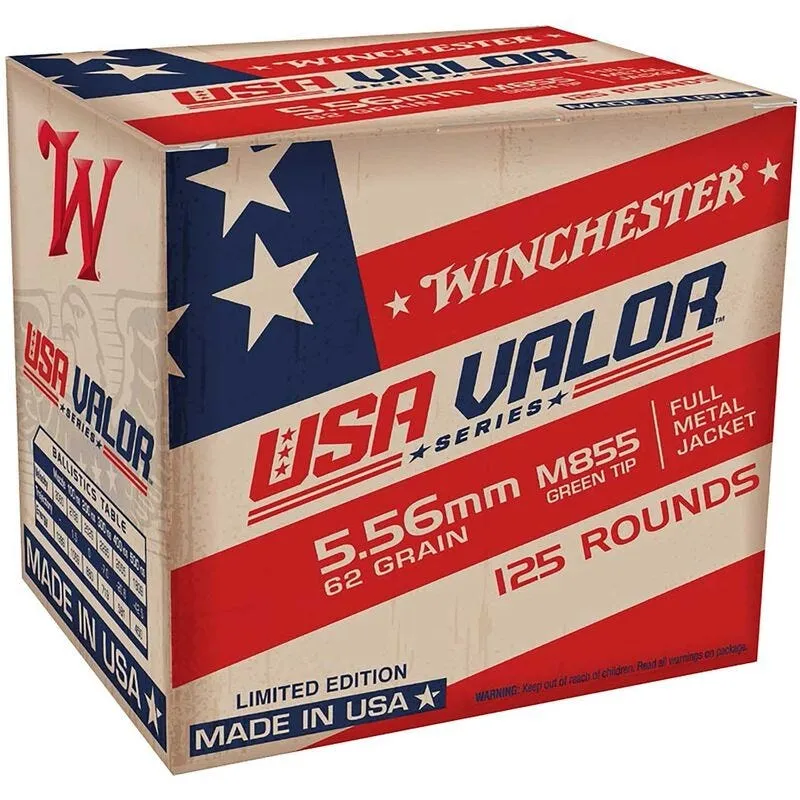
Winchester USA Valor 62 gr FMJ M855 5.56x45 Ammunition, 125 Rounds - USA855125
5.56x45mm NATO · 62gr · 125 rds

MAGTECH 5.56 x 45 62Gr FMJ 3100 FPS 50rd
5.56x45mm NATO · 62gr · 50 rds

Hornady Frontier Brass Bulk 5.56 55 Grain 150-Rounds FMJ
5.56x45mm NATO · 55gr · 150 rds
One pattern in that grid holds across effectively our whole record: case and battle-pack quantities own the bottom. A twenty-round box carries the same packaging and shipping overhead as a thousand-round case, spread across fifty times fewer rounds. Twenty-round boxes are how you buy a specific load for a specific purpose, not how you buy practice ammunition.
Before you commit, run the delivered cost rather than the sticker:
Cost Per Round Calculator
The only number that matters when comparing ammo. Shipping included.
Shipping is the usual reason a floor price stops being a floor price, and rifle ammunition is heavy. Some destinations add restrictions on top of that, which is a separate check worth doing before checkout — see ammo shipping restrictions for how to verify what applies where you live, and confirm current rules with the retailer and your own state before ordering.
So where is 5.56 heading?
Here is the sentence: we do not know, and we are not going to pretend otherwise.
That is not modesty. The dominant force in ammunition pricing is consumer demand surging, and surges are triggered by events — legislative, political, geopolitical — that are not on a schedule. A price series contains no information about them. Anyone publishing a confident 5.56 price forecast is either extrapolating a straight line or guessing, and the market has punished both approaches repeatedly. The five forces that genuinely move these numbers are laid out in why ammo prices move.
What the 30-day figure in our index does tell you is narrower and real: it compares each tracked listing against itself across two windows and reports the average move. Only listings observed in both windows count, and if there are fewer than eight such pairs we show nothing rather than dress up noise as a trend. That is a description of what already happened to inventory we watch. It is not a prediction, and it should not be traded on as one.
There is one structural exception worth knowing. Newly introduced chamberings behave differently from established ones, for reasons of production volume and retail shelf competition rather than performance — that dynamic is predictable enough to write about, and it is in what actually happens when a new cartridge launches. 5.56 is the opposite case: a mature, high-volume, multi-manufacturer cartridge, which is precisely why its floor is comparatively stable and why nobody gets rich timing it.
How to actually use this
Three things, and they replace forecasting entirely.
Set a trigger price, not a target date. Decide the cost per round at which a case purchase makes sense for you, based on the current floor rather than a price you remember, and buy when the market reaches it. A number you can verify beats a month you are guessing at.
Buy at the case level or do not bother optimizing. A five-cent per-round difference is $50 across a thousand rounds and $1 across twenty. If you are buying boxes, buy the load that suits the job and stop reading price tables — best 5.56 and .223 ammo sorts the loads by what they are for.
Know the alternative. For high-volume rifle shooters, loading your own is the real lever, and whether it pays at the current floor is arithmetic rather than opinion. We ran it in is reloading still cheaper than buying ammo. Meanwhile, the same logic applied to the handgun side is in best 9mm ammo.
Every tracked listing sorted by cost per round lives on the .223 / 5.56 caliber page. The same read across every cartridge we follow is on the ammo price index, and the whole catalog is at all tracked ammunition.
If you would rather not check by hand, name your number and let the floor come to you:
Get alerted when 5.56x45mm NATO price drops hit.
We watch every listing and email you the moment the cost per round drops.
Set Up a Free Price AlertAmmoSpotter earns a commission when you buy through links on this page. It never changes what you pay, and it never decides what we recommend — our picks are ranked on live cost-per-round data pulled from every retailer we track. Full disclosure.
Frequently Asked Questions
Why does 5.56 cost more per round than 9mm?+
Is .223 Remington cheaper than 5.56 NATO?+
Where does AmmoSpotter's 5.56 price data come from?+
Will 5.56 prices go down in 2026?+
What is the cheapest way to buy 5.56?+
Is cheap 5.56 bad ammunition?+

About the author
AmmoSpotter Research Desk
Price & Ballistics Research
The AmmoSpotter Research Desk analyzes live retail pricing across every ammunition, firearm and accessory listing we track. Recommendations here are ranked against real cost-per-round data pulled daily from the retailers we monitor - not against manufacturer marketing copy.
- ✓Tracks 180,000+ live product listings across 6 retailer feeds
- ✓Records price history on every listing, every day
- ✓Cost-per-round methodology applied to all ammunition rankings
- ✓No product is ranked without a verifiable in-stock retail price
- ✓Affiliate relationships never influence rankings
Related Guides

AmmoSpotter Ammo Price Index: What Ammunition Costs Right Now
Most published ammunition pricing is one of two things: manufacturer MSRP, which nobody pays, or a hand-updated article that was accurate the week it was written. This page is neither. Every figure below is computed a...

.223 vs 5.56: The Difference That Actually Matters
The cases are dimensionally near-identical. The ammunition will chamber in either rifle. That is exactly why this matters — nothing physically stops you from making the mistake. The two real differences 1. Pressure 5....

M193 vs M855: Which 5.56 Should You Actually Buy?
The green tip looks like a premium tier. It is not. M855 is a specialized barrier round that trades close-range fragmentation and range access for the ability to punch through light steel — and it usually costs more t...

9mm Price History: What a Round Has Cost Since We Started Tracking
Most "ammo price history" pages are a memory exercise. Someone recalls paying nineteen cents a round before 2020, quotes it as fact, and builds an argument on top of it. We took a different approach: log every price c...
Ammo Price Alerts: Why 7 in 10 Listings Cost More Than Their Own Floor
- Of 12,027 live ammunition listings in our index, 8,518 — 70.8% — are currently priced above the lowest price we have recorded for that exact product . - The median gap for those listings is 10.9% . More than a third...
Rimfire Price Index: What .22 LR Really Costs Now
.22 LR is still the cheapest way to put rounds through a gun. That part hasn't changed. What has changed is how wide the spread is inside the cartridge. A 50-round box of match ammunition and a 500-round brick of plin...