9mm vs .40 S&W
The ballistic argument ended years ago. The price and availability argument is the one that still decides this, and we can show you both live.
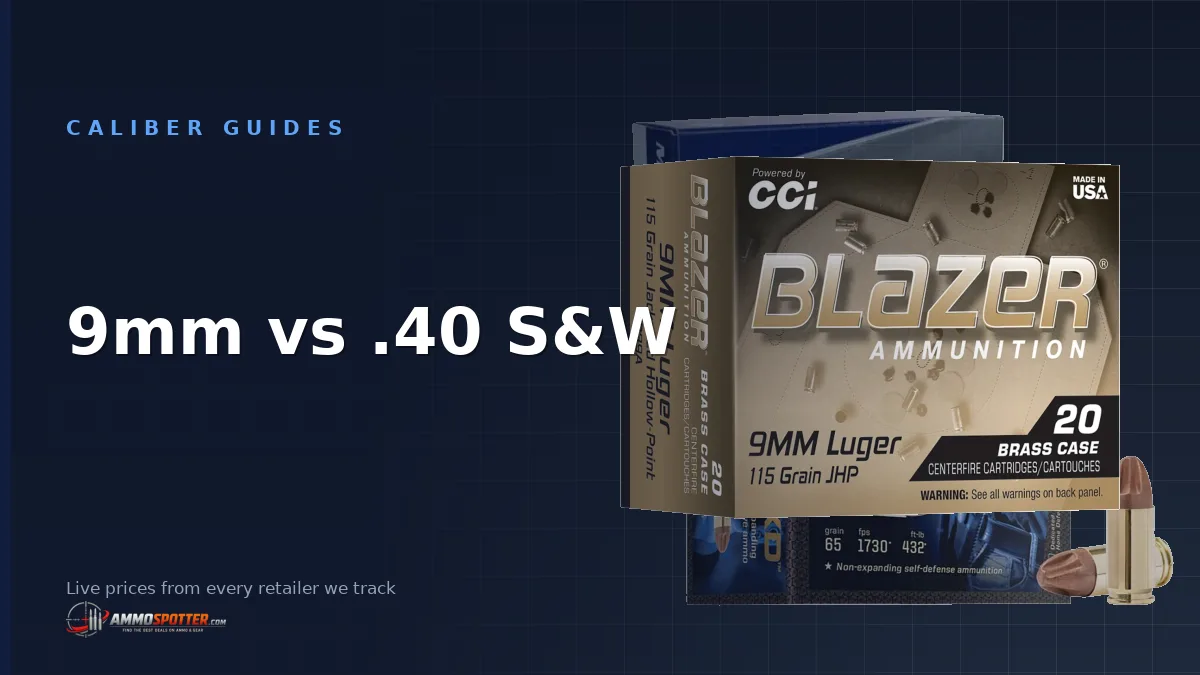
What does .40 S&W actually cost compared to 9mm right now?
This is the part of the argument that most comparisons hand-wave, because most sites cannot answer it. We track every listing from every retailer in our network and normalize it to cost per round, so the answer is a number rather than an impression.
Here is 9mm as of today:
9mm Luger Price Index
Live · Sep 21, 2026And here is .40 S&W, computed the same way, from the same retailers, on the same day:
.40 S&W Price Index
Live · Sep 21, 2026Two things to read out of those blocks. The first is the market floor — the cheapest genuinely transactable cost per round, not a single mispriced feed row. That is the number that sets your practice budget. The second is the market average, which tells you what the caliber costs when you are not hunting for the bottom. The spread between floor and average is wider in 9mm than in .40 S&W, and that is itself informative: 9mm has enough competing listings that the bargain end pulls a long way below the middle of the market.
Why is .40 S&W more expensive when the case is the same size?
It is not a materials story. A .40 S&W cartridge uses marginally more lead and propellant than a 115-grain 9mm, and that accounts for a sliver of the difference at most.
The real driver is volume. 9mm is the highest-volume centerfire handgun cartridge in the world, which means it is produced on the most lines, by the most manufacturers, in the longest runs, with the most importers competing on the low end. Our 9mm catalog carries 702 quality-filtered ammunition listings; the .40 S&W catalog carries roughly 300. Every one of those 9mm listings is a retailer trying to undercut another one. Scale of production and density of competition both push the same direction.
The same forces that set the baseline also govern how each caliber behaves in a shortage — we walk through the mechanics of that in Why Ammo Prices Move: The Five Forces Behind Every Spike. The short version for this comparison: thin catalogs spike harder and recover slower. When demand surges, a caliber with half the listings runs out of cheap inventory in half the time, and nobody spins up a new production line for it.
Here is where the .40 S&W market actually bottoms out today:
Cheapest .40 S&W Per Round Right Now
Prices updated Sep 21, 2026
MAGTECH 40 SW 180Gr 990 FPS FMJ 50rd
.40 S&W · 180gr · 50 rds

Winchester USA White Box Brass Bulk .40 SW 165 Grain 200-Rounds FMJ
.40 S&W · 165gr · 200 rds

Sellier and Bellot Handgun Ammunition Brass .40 SW 180-Grain 50-Rounds FMJ
.40 S&W · 180gr · 50 rds

WINCHESTER AMMO Range Pack 40 S&W 165gr FMJ Ammunition | 200 Rounds
.40 S&W · 165gr · 200 rds

Federal Champion Brass Bulk .40 SW 180 Grain 200-Rounds FMJ
.40 S&W · 180gr · 200 rds
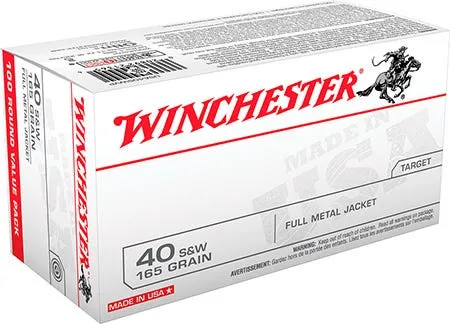
Winchester USA White Box Brass .40 SW 165-Grain 100-Rounds FMJ
.40 S&W · 165gr · 100 rds
And the 9mm equivalent, same filter, same sort:
Cheapest 9mm Per Round Right Now
Prices updated Sep 21, 2026
MAGTECH 9mm Luger Steel Case 124 FMJ 50rd
9mm · 50 rds

SELLIER BELLOT 9mm 124Gr 1200 FPS FMJ 50rd
9mm · 124gr · 50 rds

SELLIER BELLOT 9mm 115gr FMJ Brass Ammunition | 50 Rounds
9mm · 115gr · 50 rds

Winchester USA Forged 9mm 115 Grain 1000-Rounds Bulk FMJ
9mm · 115gr · 1,000 rds

Venom Ammo 9mm 124Gr FMJ Ammo 50rds - 9MM124FMJ-V50
9mm · 124gr · 50 rds

MILI CUSTOM DEFENSE AMMUNITION 9mm 155gr Subsonic FMJ 50rd
9mm · 155gr · 50 rds
How much does the price gap cost you over a year?
Take the per-round difference between those two index blocks and multiply it by your actual annual round count. That is the entire calculation, and it is worth doing honestly rather than in your head.
Cost Per Round Calculator
The only number that matters when comparing ammo. Shipping included.
The number that makes this concrete is how much you really shoot. Most people badly underestimate it in one direction or the other — we worked through realistic volumes in How Many Rounds Does It Take to Get Good?, and the answer for anyone pursuing actual competence is higher than a box or two a year. At meaningful training volumes the caliber premium compounds into real money, and it does so every single year you own the gun.
This is the argument that quietly decided the issue for police departments and competitive shooters alike. Not that .40 S&W was bad, but that the same training budget bought materially more repetitions in 9mm. If you want the full cost-of-ownership framing by caliber, we broke it out in The Real Cost of a Year of Training by Caliber.
Is the recoil difference big enough to matter?
Yes, and the trade-off deserves to be stated plainly rather than sold.
.40 S&W runs a heavier bullet at higher chamber pressure in a case with the same external footprint as 9mm. The pistol has to handle that in the same slide mass and the same recoil spring geometry. The result is not simply "more recoil" — it is a faster, sharper impulse. Shooters describe it as snappy rather than heavy, and that distinction matters because a sharp impulse is harder to ride out than a slow push of the same energy.
Where it shows up first is not felt discomfort. It is your split times and your second-shot accuracy. If you are shooting one careful round every few seconds, you may notice nothing. If you are shooting pairs at speed, or if you have smaller hands or limited grip strength, the difference is not subtle.
The counter-argument is legitimate too: in a heavy steel-framed pistol, with practice, .40 S&W is entirely manageable, and plenty of people shoot it well. The honest framing is that .40 asks more of your technique to reach the same result — and you will be paying more per round for the practice that builds that technique.
Does 9mm's capacity advantage still matter?
Less than the internet suggests. In a given frame size the 9mm version typically holds a round or two more than the .40 S&W version, because the wider .40 case takes up more room in the magazine stack. That is a real advantage, not a decisive one.
It matters most in two places: compact carry guns where every round is a meaningful percentage of the total, and competition divisions where capacity determines reload count. It matters least in a full-size home-defense pistol sitting in a safe, where the meaningful variable is how many loaded magazines you own rather than what each one holds. We made that case at length in How Many Magazines Do You Actually Need?.
Which one should you actually buy?
Buy 9mm if you are choosing a handgun caliber today with no other constraints. It is cheaper to feed, easier to shoot fast, stocked more deeply everywhere, and every current defensive load development effort is aimed at it. If you want a starting point on loads, Best 9mm Ammo 2026: Range, Carry and Duty Loads Ranked covers range, carry and duty tiers on live pricing, and you can browse the whole tracked market at 9mm ammo deals.
Buy .40 S&W if one of these is true:
- You already own the pistol. A .40 you shoot well is better than a 9mm you buy to replace it. Shoot what you have.
- The gun deal is genuinely exceptional. Agency trade-ins and the market's shift back to 9mm have put a lot of well-built duty pistols on the used rack cheaply. On our own firearm catalog, 9mm listings outnumber .40 S&W listings by roughly twenty to one — that thinner demand is exactly why the guns are cheap.
- You do not shoot much. If you genuinely fire two boxes a year, the ammunition premium never accumulates into anything, and the pistol savings are real money today.
That second point has a trap in it. A cheap .40 S&W pistol plus a decade of ammunition is not cheaper than a fairly priced 9mm plus a decade of ammunition unless you barely shoot. Do the arithmetic against your real round count, not your aspirational one.
Current .40 S&W pricing across the tracked market is at .40 S&W ammo deals. If you are buying either pistol online, How to Buy a Gun Online: FFL Transfers Explained covers the transfer process end to end.
What we are not telling you
We do not run terminal ballistics testing, and we will not pretend otherwise. Any comparison that hands you specific expansion or penetration figures for these two cartridges is either citing someone else's protocol work or making it up, and you deserve to know which. Published gel-protocol results from the manufacturers and from independent testers are worth reading on their own terms.
What we can tell you is exactly what each caliber costs, at every retailer, right now, and how that has moved. That is the part of this decision nobody else can answer for you with data — our full ranking methodology and the claims we refuse to make are documented in How AmmoSpotter Ranks Ammunition.
Get alerted when 9mm price drops hit.
We watch every listing and email you the moment the cost per round drops.
Set Up a Free Price AlertAmmoSpotter earns a commission when you buy through links on this page. It never changes what you pay, and it never decides what we recommend — our picks are ranked on live cost-per-round data pulled from every retailer we track. Full disclosure.
Frequently Asked Questions
Is .40 S&W more expensive than 9mm?+
Does .40 S&W actually kick harder than 9mm?+
Why did police departments switch from .40 S&W back to 9mm?+
Can I convert a .40 S&W pistol to 9mm?+
Is .40 S&W ammo harder to find than 9mm?+
Is a used .40 S&W pistol a good deal?+
Shop the data

About the author
AmmoSpotter Research Desk
Price & Ballistics Research
The AmmoSpotter Research Desk analyzes live retail pricing across every ammunition, firearm and accessory listing we track. Recommendations here are ranked against real cost-per-round data pulled daily from the retailers we monitor - not against manufacturer marketing copy.
- ✓Tracks 180,000+ live product listings across 6 retailer feeds
- ✓Records price history on every listing, every day
- ✓Cost-per-round methodology applied to all ammunition rankings
- ✓No product is ranked without a verifiable in-stock retail price
- ✓Affiliate relationships never influence rankings
Related Guides

115gr vs 124gr vs 147gr 9mm: Which Bullet Weight Should You Buy?
Grain weight is the first spec on a 9mm box and the one people overthink most. Three loadings dominate the market — 115, 124 and 147 grain — and the actual differences between them are smaller than the internet sugges...

Best 9mm Ammo 2026: Range, Carry and Duty Loads Ranked
9mm Luger is the most-produced, most-competitive cartridge in the American market. That is good news and bad news: prices are low, and the sheer number of listings makes it easy to pay 30% more than you needed to for ...
The Real Cost of a Year of Training, by Caliber
The gun is a one-time cost. The ammunition is the bill that arrives every year for as long as you own it, and for most shooters it passes the purchase price of the firearm within two or three seasons. The number itsel...

Best Concealed Carry Ammo by Caliber (2026): Live Prices for Every Carry Cartridge
- Pick the caliber you shoot well in a gun you will carry daily. Every mainstream carry cartridge works; none of them compensate for a miss. - Carry-load cost is nearly irrelevant — it is one magazine. Practice cost i...
9mm vs .380 ACP: Why the Smaller Round Costs More
- .380 ACP costs more per round than 9mm, even though it is the smaller cartridge. That is a supply fact, not a materials fact. - The mechanism is pack size: 9mm has a deep bulk tier and .380 effectively does not. - T...

How to Buy a Gun Online: FFL Transfers Explained
- A firearm bought online ships to a licensed dealer near you, not to your door. You do the paperwork and the background check in person. - The transfer fee is set by that receiving dealer. It is invisible to every pr...