Which Calibers Got More Expensive This Year
Every price block on this page is queried live when you load it. Read the direction cell cartridge by cartridge and you get the movers list, current to the minute, with no remembered numbers in the way.

"Are ammo prices going up" is a question about direction, and almost every answer you will find online answers a different question — level. Someone remembers paying less, quotes the number they remember, and calls the difference an increase. That is not a measurement. It is nostalgia with a dollar sign attached.
Direction is measurable, and it is measurable per cartridge, because ammunition is not one market. It is a few dozen loosely coupled markets that happen to share a supply chain. In any given month some of them are climbing and some are drifting down, and knowing which is which is the only version of this question with a useful answer.
Every price block below is a query run against our tracked listings at the moment you loaded this page. Nothing in the prose states a number that could go stale, because the numbers are not in the prose.
Are ammo prices going up right now?
Start with the two cartridges that set the tone for everything else, because between them they account for most of the rounds fired in the United States in a given year.
9mm Luger Price Index
Live · Oct 21, 2026.223 Remington / 5.56 NATO Price Index
Live · Oct 21, 2026Read the fourth cell. That is the 30-day direction, red for up and green for down, and it is the closest thing to an honest answer to the headline question that anyone can give you without knowing which gun you own.
Note also the distance between the market floor and the market average in each block. That gap is the discount available to a buyer who compares instead of defaulting to one retailer, and it is often a larger number than any recent price move. A cartridge that "went up" a couple of percent while a wide floor-to-average spread remains open is still cheaper to buy well than it was to buy badly last month.
How we measure a price move, and why most ammo price charts are wrong
The obvious way to build an ammunition price trend is to average every listing this week and compare it to the average of every listing a month ago. It is also wrong, and wrong in a way that produces dramatic, publishable, completely fictional swings.
The problem is the basket. Our catalog contains 20-round boxes and 1,000-round cases, brass and steel, birdshot and buckshot. Listings do not reprice on a common schedule. If bulk cases happened to update their prices this week and small boxes updated last month, the naive comparison reports a collapse in ammunition prices when nothing moved at all.
So we do it by matched pairs. Every listing is compared against itself across the two windows, the per-listing changes are averaged, and a listing that was not observed in both windows does not vote. We also require a minimum number of matched pairs before reporting any direction, because three listings agreeing is a coincidence, not a trend.
The same discipline governs what we will and will not claim about products. How we rank ammunition lays out the rest of it, including the things we refuse to assert. If you want the forces underneath the numbers rather than the measurement of them, why ammo prices move covers the five that actually matter.
Rimfire moves the most in percentage terms
Rimfire is where the percentage swings look alarming and the dollar impact is smallest.
.22 LR Price Index
Live · Oct 21, 2026.22 WMR Price Index
Live · Oct 21, 2026A fraction of a cent is a large share of a rimfire round and a rounding error on a centerfire one. That arithmetic means .22 LR will routinely post the biggest percentage move on this page while costing a high-volume plinker very little in absolute terms. Do not let the percentage panic you into buying a brick you did not want.
The reverse trap is worse and more common: ignoring a small percentage move on an expensive cartridge because the number looks tame. On a magnum hunting round, a move that reads as unremarkable can be more dollars per box than a dramatic-looking rimfire swing.
Handgun calibers: 9mm leads, the rest follow at a distance
9mm is the volume cartridge, and its direction generally arrives at the other handgun calibers later and softer, because the plants that load it are the plants that load them.
.45 ACP Price Index
Live · Oct 21, 2026.380 ACP Price Index
Live · Oct 21, 2026.38 Special Price Index
Live · Oct 21, 2026The revolver cartridges are the interesting case here. .38 Special and .357 Magnum are produced in far smaller volumes than 9mm, which makes them more sensitive to a single manufacturer reallocating a line — the kind of event that barely registers on a cartridge with a dozen sources.
.357 Magnum Price Index
Live · Oct 21, 2026If 9mm is what you shoot, the 9mm caliber page ranks the entire tracked field by cost per round, and best 9mm ammo covers which loads are worth buying once you have found a price you like.
Cheapest 9mm by Cost Per Round
Prices updated Oct 21, 2026
Winchester USA Forged 9mm 115 Grain 1000-Rounds Bulk FMJ
9mm · 115gr · 1,000 rds

CCI Ammunition Blazer Aluminum 9mm 115-Grain 1000-Rounds Bulk FMJ
9mm · 115gr · 1,000 rds

Aguila Centerfire Handgun Bulk 9mm 115 Grain 300-Rounds FMJ
9mm · 115gr · 300 rds
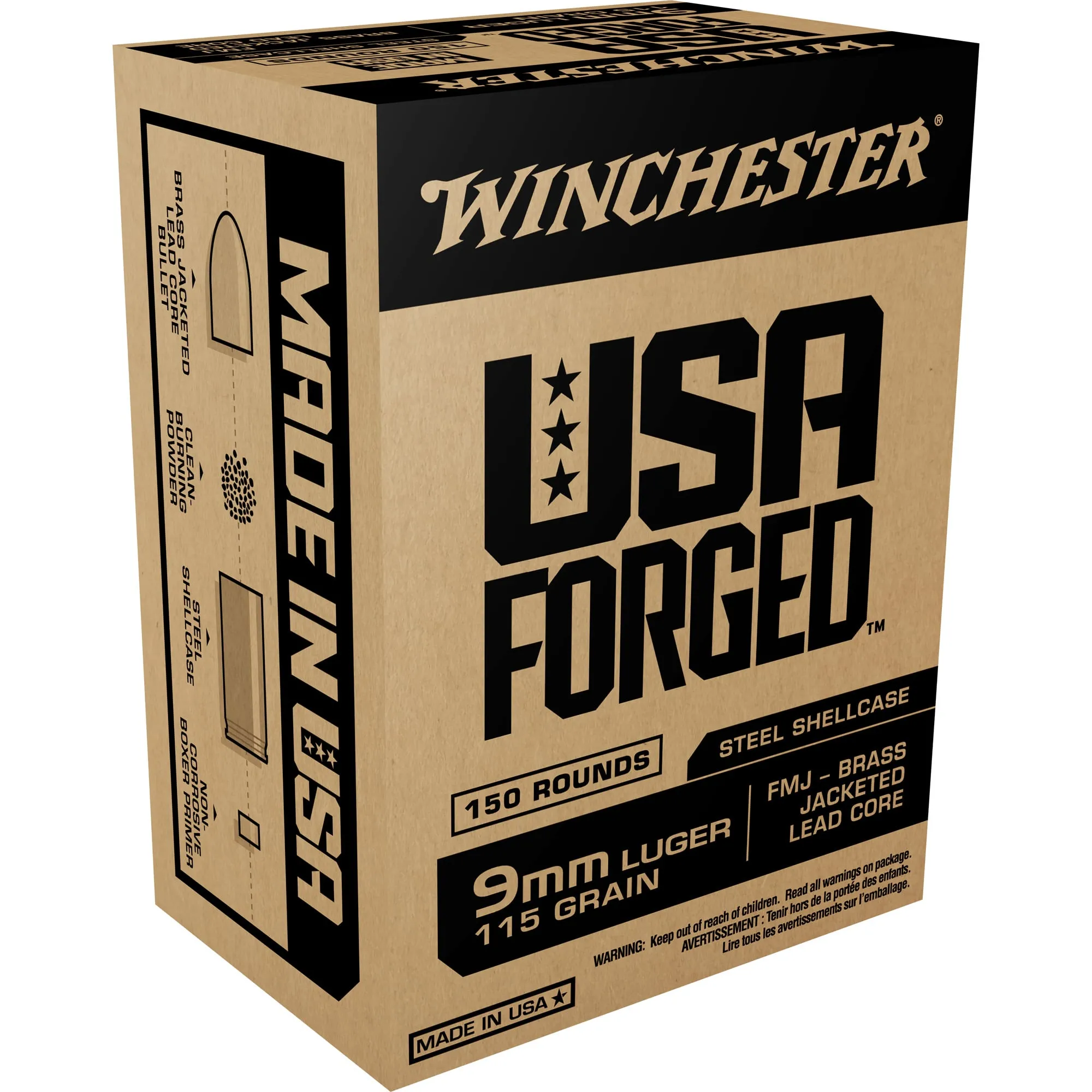
Winchester USA 9mm Ammunition, 1000 Rounds FMJ 115Gr - WIN9SK
9mm · 115gr · 1,000 rds

Aguila Centerfire Handgun Bulk 9mm 124-Grain 300-Rounds FMJ
9mm · 124gr · 300 rds

PMC Ammunition Bronze Brass 9mm 115-Grain 1000-Rounds Bulk FMJ
9mm · 115gr · 1,000 rds
Rifle calibers split into two different markets
There is the commodity rifle market — 5.56, .223, 7.62x39, .300 Blackout — and there is the hunting cartridge market, and they behave nothing alike.
7.62x39mm Price Index
Live · Oct 21, 2026.300 Blackout Price Index
Live · Oct 21, 2026Commodity rifle ammunition is deep, heavily discounted and imported in volume, so it moves on component costs and trade policy. Hunting cartridges are shallower, more brand-driven and far more seasonal, and their price behavior in late summer is dominated by one thing: the season that is about to open.
.308 Winchester Price Index
Live · Oct 21, 20266.5 Creedmoor Price Index
Live · Oct 21, 2026.30-06 Springfield Price Index
Live · Oct 21, 2026If your cartridge is on that second list and the direction cell is red, you are seeing hunting demand arriving, not a structural shift. Best deer hunting ammo by caliber covers which loads justify the seasonal premium and which do not. For the practice half of your round count, best 5.56 and .223 ammo is the cheaper way to keep skills current without burning hunting ammunition.
A cartridge that keeps climbing is also the standard argument for rolling your own. Is reloading still cheaper than buying ammo runs that comparison against live component prices rather than a decade-old rule of thumb, and the answer is cartridge-specific.
Shotshells climb into bird season, every year
12 Gauge Price Index
Live · Oct 21, 202620 Gauge Price Index
Live · Oct 21, 2026Shotshell is the most seasonally legible category we track. Target loads and field loads are commodities produced in enormous volume, and the annual demand pulse from dove, waterfowl and upland seasons is large enough to be visible in the data. It is also the category where the floor-to-average gap is widest, because a case of target loads and a box of premium waterfowl shells are barely the same product.
Buy target loads by the case ahead of the season and the seasonal move mostly stops mattering to you.
What to do about a caliber that is going up
A rising trend is information, not an instruction. Four responses are defensible, in roughly this order.
Check the level before reacting to the direction. If the market floor is still low relative to the market average, the discounters have not capitulated and there is a real price available to whoever compares. A rising trend on a cartridge that is cheap in absolute terms is not an emergency.
Buy your baseline, not a bunker. If you know roughly how many rounds a year you shoot, buying that volume steadily beats trying to time a market that reprices on events nobody scheduled. How many rounds does it take to get good is the honest version of the volume question, and it is the number your purchasing should be built around.
Normalize before you congratulate yourself. Box price is not round price, and a sale on a 20-round box frequently loses to full retail on a 500-round case once shipping lands.
Cost Per Round Calculator
The only number that matters when comparing ammo. Shipping included.
Let the market tell you instead of checking. The one strategy that reliably beats watching is not watching — set a threshold and get told when it is crossed.
Get alerted when 9mm price drops hit.
We watch every listing and email you the moment the cost per round drops.
Set Up a Free Price AlertWhat this data cannot tell you
Three limits, stated plainly, because a data page that will not name its own boundaries should not be trusted.
We track retail listings, not manufacturer costs. We can tell you what the market is charging and which way it is moving; we cannot tell you why a specific plant changed a specific price, and we will not speculate in numbers.
Our continuous matched-pairs record covers this year, not a decade. That is enough to measure direction and to catch a move while it is happening. It is not enough to make confident claims about where a cartridge sits against its long-run history, so we do not make them.
And a price is not an offer. Listings go out of stock, and the cheapest tracked row is worth nothing if the retailer will not ship to your address. Shipping and possession rules vary by state and locality and they change — ammo shipping restrictions explains how to check yours before you order rather than after.
For the market-wide view across every cartridge we track, the ammo price index carries the same read continuously. If the cartridge you care about is new enough that its pricing still looks unstable, what actually happens when a new cartridge launches explains why that is normal and roughly how long it lasts. Or skip the analysis entirely and sort all tracked ammunition by cost per round.
AmmoSpotter earns a commission when you buy through links on this page. It never changes what you pay, and it never decides what we recommend — our picks are ranked on live cost-per-round data pulled from every retailer we track. Full disclosure.
Frequently Asked Questions
Are ammo prices going up right now?+
How do you measure whether a caliber got more expensive?+
Which calibers move the most?+
Should I stock up when a caliber starts climbing?+
Does a rising price index mean there is a shortage?+
Why does the same cartridge show a different price on two retailers?+
Shop the data

About the author
AmmoSpotter Research Desk
Price & Ballistics Research
The AmmoSpotter Research Desk analyzes live retail pricing across every ammunition, firearm and accessory listing we track. Recommendations here are ranked against real cost-per-round data pulled daily from the retailers we monitor - not against manufacturer marketing copy.
- ✓Tracks 180,000+ live product listings across 6 retailer feeds
- ✓Records price history on every listing, every day
- ✓Cost-per-round methodology applied to all ammunition rankings
- ✓No product is ranked without a verifiable in-stock retail price
- ✓Affiliate relationships never influence rankings
Related Guides

AmmoSpotter Ammo Price Index: What Ammunition Costs Right Now
Most published ammunition pricing is one of two things: manufacturer MSRP, which nobody pays, or a hand-updated article that was accurate the week it was written. This page is neither. Every figure below is computed a...

Why Ammo Prices Move: The Five Forces Behind Every Spike
From the outside, ammunition pricing looks arbitrary. One cartridge climbs while another does not. A caliber that was plentiful in spring is thin by autumn. Prices rise fast and fall slowly. It is not arbitrary. Five ...

When Is the Cheapest Time of Year to Buy Ammo? (2026)
The question assumes ammunition behaves like patio furniture — that there is a predictable end-of-season dip, and that a patient buyer beats an impatient one by waiting for it. It does not work that way. The forces th...

Cost Per Round: The Only Ammo Price Metric That Matters
There is exactly one reason ammunition is hard to price-compare: it is advertised in boxes and consumed in rounds. Box counts are not standardized. A "box" of 9mm might be 50 rounds. A "value pack" might be 100, or 11...

What Is Driving Ammo Prices Right Now: A Live Read of the Market
- There is no single "ammo price." There is a floor, an average and a trend, and they differ per cartridge — the blocks below are live, not typed in. - Market-wide averages hide the thing you care about. Dispersion be...

When to Buy Hunting Ammo: What Our Price Record Shows About the Season Curve
- We compared every hunting-caliber listing against itself between March and August 2026. Nearly all of them got more expensive. - Shotshells moved hardest: 12 gauge +8.57%, 20 gauge +7.94% over the window. - Deer rif...