Best .308 Winchester Ammo
The gap between the cheapest .308 we track and the catalog average is roughly three to one — which load you buy matters less than knowing which tier you are shopping in.

What does .308 Winchester actually cost right now?
Here is the live market, priced per round across every retailer we track:
.308 Winchester Price Index
Live · Oct 22, 2026The number worth sitting with is the distance between the floor and the average. As of this writing the market floor is $0.650 per round and the average across all 374 live .308 listings is $1.945 — roughly three to one.
That ratio is much wider than what we see in 5.56 and .223 or 9mm, and it is not because .308 buyers are being gouged. It is a composition effect. The .308 catalog is dominated by hunting and match loads with expensive bullets in 20-round boxes, and only a thin band of cheap FMJ underneath it. In 9mm the cheap tier is the market. In .308 it is a minority of the listings.
The practical consequence: "what does .308 cost" is an unanswerable question until you say which tier you are shopping. Below is the bottom of the range.
Cheapest .308 Winchester Per Round Right Now
Prices updated Oct 22, 2026
BARNAUL AMMO 308 WIN 145Gr FMJ Poly Coated Steel Case 20rd
.308 Winchester · 145gr · 20 rds

BARNAUL AMMO 308 Win 150Gr HPBT Polycoated Steel Case 20rd
.308 Winchester · 150gr · 20 rds

BARNAUL AMMO 308 Win 145Gr FMJ Zinc Steel Case 20rd
.308 Winchester · 145gr · 20 rds

BARNAUL AMMO 308 Win 140gr SP Polycoated Steel Case 20rd
.308 Winchester · 140gr · 20 rds

BARNAUL AMMO 308 Win 168Gr SPBT Polycoated Steel Case 20rd
.308 Winchester · 168gr · 20 rds

BARNAUL AMMO 308 Win 168Gr FMJBT Polycoated Steel Case 20rd
.308 Winchester · 168gr · 20 rds
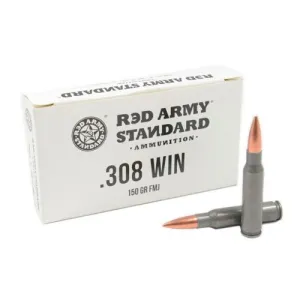
RED ARMY STANDARD 308 Win 150Gr FMJ Steel Case 20rd
.308 Winchester · 150gr · 20 rds
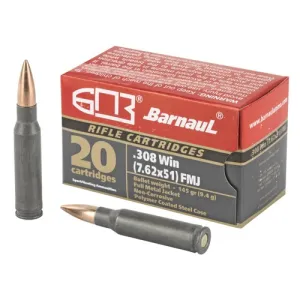
BARNAUL AMMO 308 Win 145gr FMJ Brass Polycoated Steel Case 20rd
.308 Winchester · 145gr · 20 rds
The cheapest .308 is steel-case, and that is a real trade-off
The floor of this cartridge is held down by imported steel-case FMJ. The single cheapest .308 in our catalog right now is Barnaul 145-grain FMJ in a polymer-coated case at $11.99 for 20 rounds — $0.600 per round, and also the cheapest box of .308 we track at any round count. Several other Barnaul loads and Red Army Standard 150-grain FMJ sit at $0.650 to $0.700.
What you are accepting for that price is worth stating plainly rather than hand-waving. Polymer- or lacquer-coated steel cases do not obturate the way brass does, which tends to mean dirtier chambers over long strings. Extraction is less forgiving in a semi-auto with a tight chamber. The cases are not reloadable, so if you were planning to save brass, the savings are smaller than they look. And supply is import-dependent and historically erratic — what is listed today may not be listed next quarter.
Steel case vs brass covers the mechanics in full. The short version for .308 specifically: in a bolt gun shooting a few hundred rounds a year, steel case is a defensible way to cut your practice cost roughly in half. In a gas gun you run hard, or if you reload, the math gets worse quickly.
What should you pay for brass-case practice .308?
If you want brass, the entry point is higher and much narrower than most people expect.
The cheapest brass practice loads we currently track cluster just under and around a dollar a round: Armscor 147-grain FMJ at $18.99 for 20 ($0.950), Sellier & Bellot 147-grain FMJ at $19.19 ($0.960), and PMC Bronze 147-grain FMJBT at $19.99 for 20 ($1.050). Sellier & Bellot's cheapest listing across our whole .308 catalog is $1.000 per round; Fiocchi's is $1.135.
So the honest framing is that brass-case .308 practice ammo costs somewhere around 50 to 75 percent more per round than the steel-case floor. That is the actual decision — not "which brand is best," but whether reusable brass and cleaner cycling are worth that specific premium for the way you shoot. If you already reload, they usually are, and the reloading math for .308 is more favorable than it is for the small-caliber cartridges, precisely because factory .308 is expensive.
.308 is not a bulk caliber, and that changes how you buy it
This is the finding that surprises people moving over from an AR-15.
Almost every .308 listing we track ships as a 20-round box. Case-sized packaging barely exists in this cartridge, and where it does, it is not automatically cheap: the PMC Bronze 500-round case at $489.99 works out to $0.980 per round, which is more than the steel-case boxes above and roughly the same as the cheapest brass 20-round boxes. You are paying for one shipment, not for a discount.
The generic advice that bulk saves money is really advice about specific bulk listings, and we found the same thing looking across the whole catalog in is bulk ammo actually cheaper. In .308 it collapses almost entirely. Buy the box that is cheapest per round, order enough of it in one go to clear a free-shipping threshold, and stop looking for a case that mostly is not there.
Shipping is a larger share of the total on a heavy rifle cartridge than it is on pistol ammo, and destination restrictions vary and change. Check before you order rather than trusting any static list, including ours.
Which .308 hunting load should you actually buy?
Hunting is where most .308 gets bought, and where the per-round price stops being the main variable.
The mainstream factory weights are 150, 165 and 180 grains. For deer-sized game at ordinary ranges, all three work, and arguing about which is "the" deer weight is a poor use of attention. What matters more is bullet construction — a controlled-expansion or bonded soft point holds together on heavy bone in a way a cheap cup-and-core soft point may not, and that difference shows up on recovery, not on paper.
We do not run terminal ballistics testing and will not pretend otherwise. How we rank ammunition spells out exactly what we will and will not claim: we rank on live price, availability across retailers and published manufacturer specification, and we defer to published gel-test protocols for terminal performance rather than inventing numbers. For a caliber-by-caliber look at what people actually take deer with, best deer hunting ammo by caliber is the companion piece.
On price, the major hunting brands land in a fairly tight band at their cheapest. As of this writing the lowest listing we have from Nosler is $1.193 per round, Norma $1.200, Winchester $1.295, Hornady $1.320, Remington $1.342 and Federal $1.435. Those are the floor of each brand's range, not typical — the premium bonded and monolithic loads sit well above them.
Live .308 Winchester Listings We Rate Highest
Prices updated Oct 22, 2026
PMC Ammunition Bronze Target .308 Win 147-Grain 20-Rounds FMJBT
.308 Winchester · 147gr · 20 rds

Sellier and Bellot .308 Win 147GR FMJ 20rds
.308 Winchester · 147gr · 20 rds

Sellier and Bellot Rifle Brass .308 Win 180-Grain 20-Rounds Soft Point Cut-Through Edge (SPCE)
.308 Winchester · 180gr · 20 rds

Sellier & Bellot .308WIN 180GR FMJ 20Rds
.308 Winchester · 180gr · 20 rds
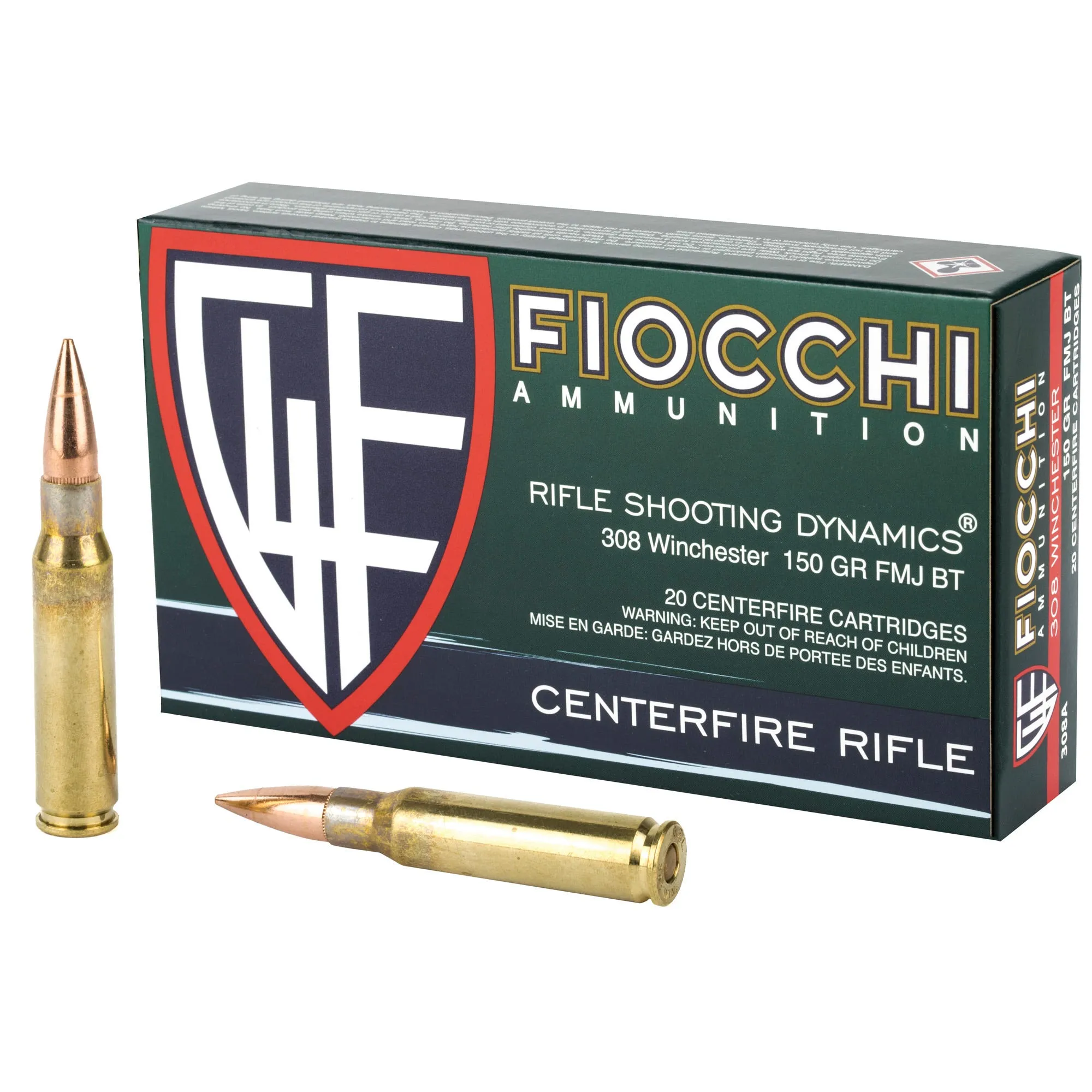
Fiocchi Range Dynamics Brass .308 Win 150-Grain 20-Rounds FMJBT
.308 Winchester · 150gr · 20 rds
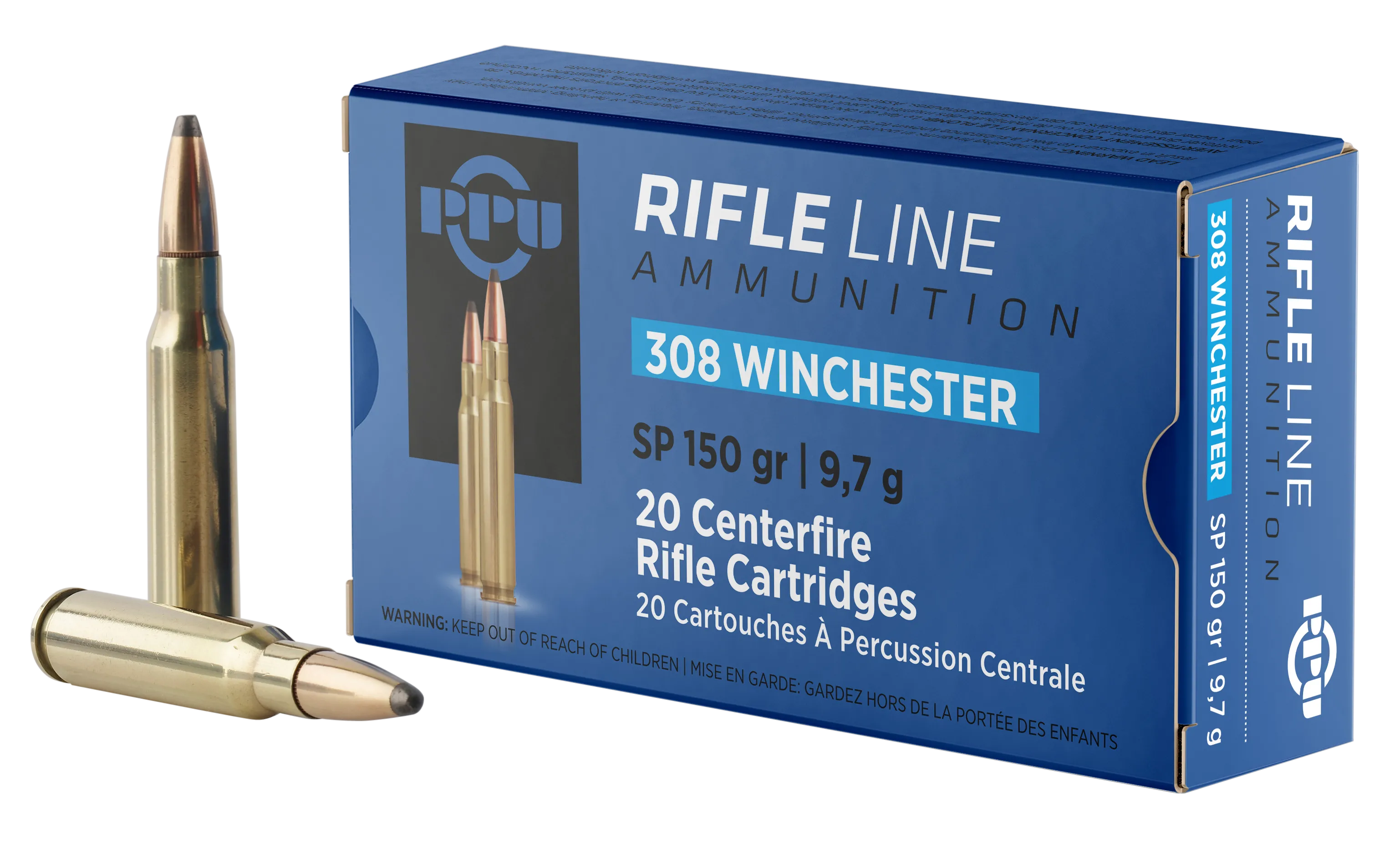
PPU Centerfire Rifle Brass .308 Win 150-Grain 20-Rounds SP
.308 Winchester · 150gr · 20 rds
Is match-grade .308 worth the premium?
Only when the rest of the system can resolve the difference.
Match .308 — typically 168- or 175-grain hollow point boat tails — buys you tighter tolerances on bullet weight, seating depth and powder charge. That consistency is real, and it is also invisible from a rifle, optic or position that cannot shoot better than the ammunition already does. Most shooters who buy match ammo are paying for precision they are not currently able to measure.
The defensible uses are narrow and worth naming: you are working up a load for a specific rifle and need a consistent baseline, you are shooting a match where the scoring rings punish a flier, or you are confirming a zero you intend to trust at distance. For everything else, the cheap tier does the job and lets you shoot three times as much — which, as how many rounds it takes to get good argues, is the variable that actually moves your groups.
.308 Winchester or 7.62x51mm NATO?
Treat them as related, not identical.
They are dimensionally close enough that the ammunition frequently gets cross-listed, but they are specified to different pressure standards and different headspace tolerances, and NATO-spec chambers are generally cut more generously. The conventional guidance runs one way: a rifle chambered to NATO spec is the more forgiving of the two, and a tight commercial .308 chamber is where caution belongs. Read your barrel markings and your manufacturer's guidance before you rely on any internet rule of thumb, including this one.
Practically, you should price both. Our .308 and 7.62x51 NATO ammo page lists every live listing in both designations, sortable by cost per round, and which one is cheaper in a given week is not predictable — the forces that move these prices are covered in why ammo prices move, and none of them run on a schedule.
Does .308 make sense through a suppressor?
It suppresses well, but not the way the cartridge is normally loaded.
Standard .308 is comfortably supersonic, so a can removes muzzle blast but not the sonic crack downrange. Subsonic .308 exists and is a genuinely quiet combination, at the cost of a heavy, slow bullet with a limited useful range and stabilization requirements your barrel's twist rate may or may not meet. It is a specialist purchase, not a general upgrade. Best ammo for suppressed shooting covers what actually goes quiet and why 300 Blackout took most of this niche.
Suppressor ownership itself is federally regulated and additionally restricted in some states, and those rules change. Verify current requirements for your own jurisdiction before you buy anything.
How to buy .308 without overpaying
- Check the live floor in the index above. It is your benchmark and it moves.
- Decide your tier first — practice, hunting or match. Comparing across tiers is how people talk themselves into overpaying.
- Sort by cost per round, never by box price. Twenty-round boxes make this easy to get wrong.
- If you are buying practice ammo, price steel case against the cheapest brass and decide the trade-off on purpose.
- Do not go hunting for a bulk case. In .308 it usually is not the cheaper option.
- Add shipping before you compare, and confirm the retailer ships to your address.
- For hunting loads, buy two boxes of a candidate and confirm your rifle groups it before you commit to a season's supply.
- If nothing is at or below the floor this week, wait. It comes back.
Browse everything live on the .308 / 7.62 NATO ammo page, or start from how to buy ammo online if you want the general method before the caliber specifics.
Get alerted when .308 Winchester price drops hit.
We watch every listing and email you the moment the cost per round drops.
Set Up a Free Price AlertAmmoSpotter earns a commission when you buy through links on this page. It never changes what you pay, and it never decides what we recommend — our picks are ranked on live cost-per-round data pulled from every retailer we track. Full disclosure.
Frequently Asked Questions
What is a good price per round for .308 Winchester?+
What is the cheapest .308 ammo available?+
Can I shoot .308 Winchester in a 7.62x51mm NATO rifle?+
What grain .308 should I buy for deer?+
Is bulk .308 ammo cheaper?+
Is match-grade .308 worth the extra money?+

About the author
AmmoSpotter Research Desk
Price & Ballistics Research
The AmmoSpotter Research Desk analyzes live retail pricing across every ammunition, firearm and accessory listing we track. Recommendations here are ranked against real cost-per-round data pulled daily from the retailers we monitor - not against manufacturer marketing copy.
- ✓Tracks 180,000+ live product listings across 6 retailer feeds
- ✓Records price history on every listing, every day
- ✓Cost-per-round methodology applied to all ammunition rankings
- ✓No product is ranked without a verifiable in-stock retail price
- ✓Affiliate relationships never influence rankings
Related Guides

Best Deer Hunting Ammo by Caliber (2026): What Each Cartridge Costs to Feed
- The mainstream deer cartridges — .308 Winchester, 6.5 Creedmoor, .30-06 Springfield — cost close enough per round that price should not pick your rifle. - Cost per round is misleading on hunting ammo: you buy it in ...

Is Reloading Still Cheaper Than Buying Ammo? Run the Numbers
Reloading used to be a straightforward economic decision. It is not anymore, and the reason is that factory ammunition production volume has diverged enormously between cartridges. The honest 2026 answer: reloading sa...

Cost Per Round: The Only Ammo Price Metric That Matters
There is exactly one reason ammunition is hard to price-compare: it is advertised in boxes and consumed in rounds. Box counts are not standardized. A "box" of 9mm might be 50 rounds. A "value pack" might be 100, or 11...

Best Ammo for Suppressed Shooting: Subsonic, Supersonic and What Actually Goes Quiet
The most common disappointment with a first suppressor is that it did not make the rifle quiet. The can is usually fine. The ammunition is usually the problem. A gunshot makes three distinct noises, and a suppressor o...
.30-06 vs .308: Which Should You Buy, on Live Prices and Real Availability
This argument is older than almost everyone having it. The .30-06 Springfield has been in continuous use since before the First World War; the .308 Winchester arrived four decades later doing nearly the same job in a ...
.308 Winchester vs 7.62x51 NATO: Safe to Mix, and Which Label Costs Less
Two boxes sit on the same shelf. One says .308 Winchester, one says 7.62x51 NATO, and the internet has spent twenty years arguing about whether swapping them will hurt your rifle. The argument usually gets framed as a...