.308 Winchester vs 7.62x51 NATO
The pressure argument is mostly a measurement artifact. The headspace question is the one that actually matters — and the two labels are priced differently on the same shelf.
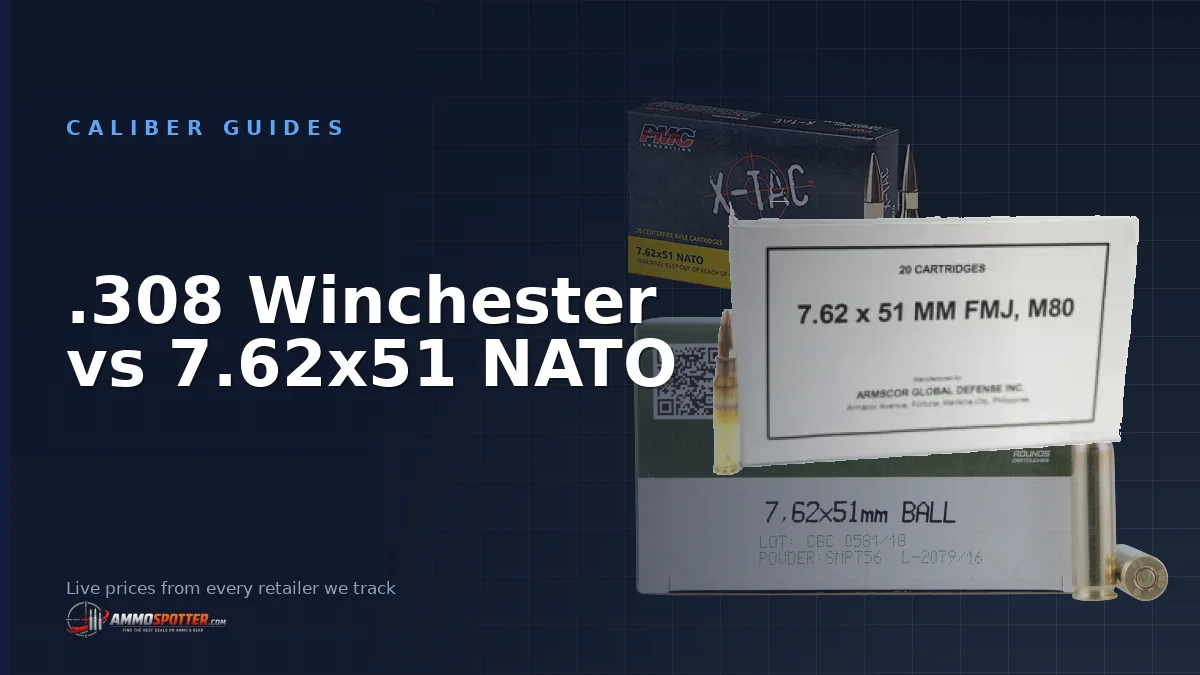
Two boxes sit on the same shelf. One says .308 Winchester, one says 7.62x51 NATO, and the internet has spent twenty years arguing about whether swapping them will hurt your rifle. The argument usually gets framed as a pressure problem. It mostly is not.
The dimensions are effectively the same cartridge. What differs is the chamber it was standardized against, and that difference shows up as headspace tolerance, not as a pressure spike. Here is what actually matters before you press the trigger, and — because we track both labels separately — what each one costs per round right now.
Are .308 Winchester and 7.62x51 NATO the same cartridge?
Close enough that the ammunition industry itself blurs the line. Several of the listings we track carry both names on one product — PMC's X-Tac and Sellier and Bellot's 147-grain ball are both catalogued as "7.62 X 51 / .308 Win," one SKU, one set of brass, two labels. If the cartridges were meaningfully different, that product could not legally exist.
The commercial round came first, as a Winchester sporting cartridge, and the military specification was standardized around it shortly after. External case dimensions — base, shoulder, neck, overall length — match. A .308 round drops into a 7.62 chamber and a 7.62 round drops into a .308 chamber without drama.
Where they genuinely diverge is in how each standards body defines the chamber and how each measures pressure. That is a specification difference, and it has practical consequences, but it is not the "one of these is loaded hotter" story that gets repeated.
Which one is actually loaded hotter?
Neither, in any way you can act on.
The .308 Winchester specification and the NATO specification publish maximum pressures using different transducer types, mounted in different places on the case, under different test protocols. Reading one number against the other is like comparing a road time to a treadmill time. Measured by a single consistent method, the two land close enough together that ammunition makers ship the same product under both labels.
What is real is variation between loads. A 168-grain match load and a 145-grain steel-case practice round behave very differently in the same rifle, and that spread within a single label dwarfs anything attributable to the NATO stamp. If you want the actual mechanism behind bullet weight and velocity choices, our grain weight explainer covers it without the folklore.
Is it safe to shoot 7.62x51 NATO in a .308 rifle?
This is the direction almost nobody argues about. The commercial .308 chamber is the tighter of the two, NATO ball is dimensionally a .308 cartridge, and a modern bolt action, AR-10 or hunting semi-auto marked .308 Winchester will run M80-spec ball without incident. Militaries have fired it through the same actions for decades.
The one thing to keep in mind is what NATO ball is: a non-expanding full metal jacket projectile built for volume and consistency, not for terminal performance on game. It is practice ammunition. Buy it because it is inexpensive, not because it is a substitute for a hunting load.
NATO-Labelled Ball We Currently Track

ARMSCOR 7.62x51 NATO M80 147Gr FMJ 20rd
Armscor 147-grain FMJ sold explicitly as 7.62x51 NATO M80. This is the load most people picture when they say NATO ball, and it is priced against the cheap end of the .308 catalog rather than the hunting end.

MagTech First Defense Tactical 7.62x51 147-Grain 50-Rounds FMJ
Magtech First Defense Tactical, 147-grain FMJ, 50 rounds to a box. The larger pack is what keeps its cost per round competitive with 20-round .308 offerings.

PMC Ammunition X-Tac Brass 7.62 X 51 / .308 147-Grain 20-Rounds FMJBT
PMC X-Tac listed as 7.62 x 51 / .308 — one SKU, one set of brass, two labels on the box. This is the clearest evidence that the retail distinction is often a marketing decision.

Sellier and Bellot Centerfire Rifle Brass 7.62 X 51 / .308 Win 147-Grain 20-Rounds FMJ
Sellier and Bellot 147-grain FMJ, also catalogued as 7.62 X 51 / .308 Win. Brass case, standard ball weight, and it appears in both of the price blocks on this page.
When does .308 in a 7.62 chamber actually matter?
Here is the caution, stated accurately rather than dramatically.
Military chambers are specified with a more generous headspace tolerance than commercial ones — the standard assumes filthy rifles, mixed-lot ammunition and belt-fed abuse, so it leaves room. A rifle sitting at the loose end of that tolerance, or a surplus rifle that has been fired hard for decades, will let a commercial case stretch more on firing than a tight commercial chamber would.
The consequence of that stretch is not a kaboom. It is shortened brass life, and in a rifle with genuinely excessive headspace, eventual case head separation — the case body tearing away from the head, which leaves the front half of the case stuck in the chamber and vents gas backwards. That is a bad afternoon, but it is a wear-and-tolerance problem, not a pressure incompatibility.
The practical rule: if the rifle is a modern commercial firearm, this is not your problem. If it is a surplus rifle, a parts-kit build or anything whose history you cannot account for, have a gunsmith check headspace with go and no-go gauges before you commit. That is a twenty-minute job and it settles the question permanently.
There is a separate, unrelated caution for gas-operated surplus designs, where slow-burning powders in some commercial hunting loads produce higher port pressure than the operating system was designed around. That is an action-specific issue, not a .308-versus-NATO one — check the manufacturer's guidance for your particular rifle.
Which label is cheaper per round right now?
This is where the two names stop being a technicality and start costing you money. We track them as separate calibers, which means you can watch both markets at once:
.308 Winchester Price Index
Live · Sep 26, 20267.62x51 NATO Price Index
Live · Sep 26, 2026Read the floor line against the floor line and the average against the average, and note that they tell different stories. The averages diverge mostly because the two labels hold different product mixes. The .308 Winchester catalog spans everything from steel-case practice ammunition to premium hunting and match loads, while the 7.62x51 listings are overwhelmingly ball ammunition in standard weights. A label full of nothing but FMJ will always average differently from a label that includes bonded hunting bullets.
Across the .308 Winchester side we currently track 380 approved live ammo listings, with a market floor of $0.650 per round and a market average of $1.963 — an almost threefold spread inside a single caliber. The cheapest box in the catalog sits at $11.99. That range is the actual story of this cartridge: what you pay depends far more on what kind of .308 you are buying than on which of the two names is printed on it.
Cheapest .308 / 7.62x51 Per Round
Prices updated Sep 26, 2026
BARNAUL AMMO 308 WIN 145Gr FMJ Poly Coated Steel Case 20rd
.308 Winchester · 145gr · 20 rds

BARNAUL AMMO 308 Win 145Gr FMJ Zinc Steel Case 20rd
.308 Winchester · 145gr · 20 rds

BARNAUL AMMO 308 Win 140gr SP Polycoated Steel Case 20rd
.308 Winchester · 140gr · 20 rds

BARNAUL AMMO 308 Win 150Gr HPBT Polycoated Steel Case 20rd
.308 Winchester · 150gr · 20 rds

BARNAUL AMMO 308 Win 168Gr SPBT Polycoated Steel Case 20rd
.308 Winchester · 168gr · 20 rds

BARNAUL AMMO 308 Win 168Gr FMJBT Polycoated Steel Case 20rd
.308 Winchester · 168gr · 20 rds
The floor is held by steel-case practice ammunition, which carries its own trade-offs — extraction behavior, non-reloadable cases, and ranges that ban it outright. We went through those in detail in steel case vs brass; the short version is that the savings are real and so are the restrictions.
Does buying by the case change the math?
It does, and it is the one lever that reliably moves cost per round in this cartridge. Twenty-round boxes dominate the .308 catalog, which is part of why its floor sits well above what the high-volume intermediate cartridges manage. Case-quantity listings are where the per-round figure drops.
Bulk .308 / 7.62x51: 100 Rounds and Up
Prices updated Sep 26, 2026
PMC Ammunition Bronze Brass .308 Win 147 Grains 500 Round Case Bulk FMJBT
.308 Winchester · 147gr · 500 rds
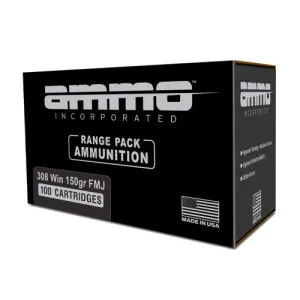
AMMO INC 308 Win 150Gr FMJ Signature Rifle 100rd
.308 Winchester · 150gr · 100 rds

PPU Rangemaster Brass 7.62 X 51 145-Grain 500-Rounds Bulk FMJBT
7.62x51mm NATO · 145gr · 500 rds

WINCHESTER AMMO 7.62x51 M80 149 FMJ Win LC 7500rd Drum
7.62x51mm NATO · 7,500 rds
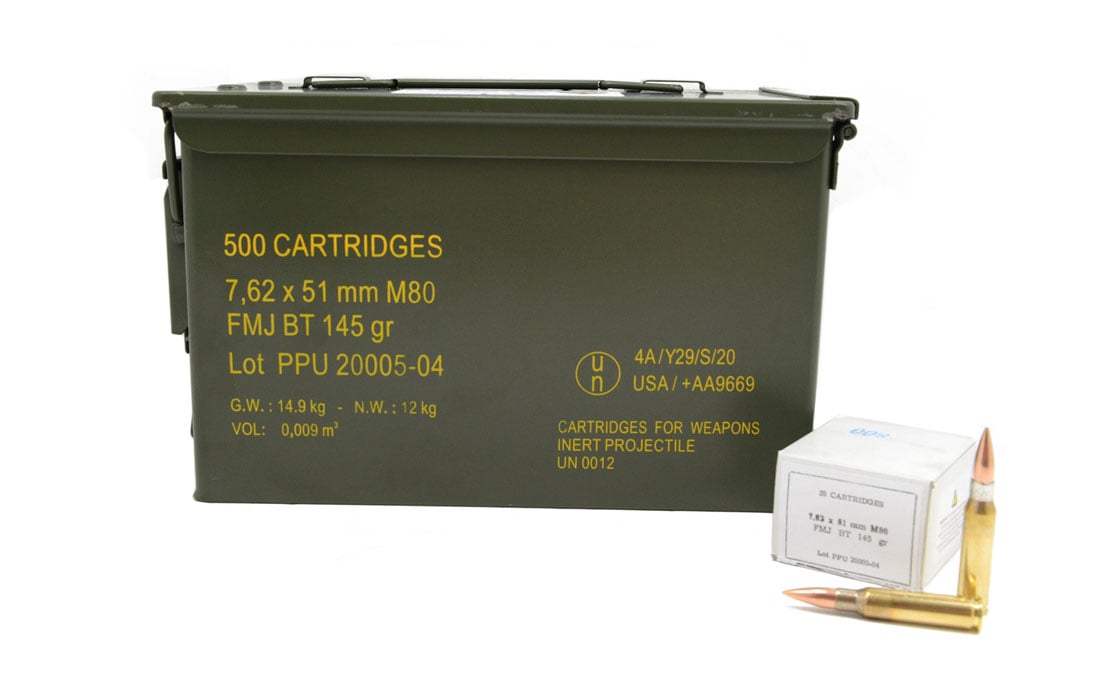
PPU RangeMaster 7.62x51 NATO 145gr FMJ-BT 500rd Can
7.62x51mm NATO · 145gr · 500 rds
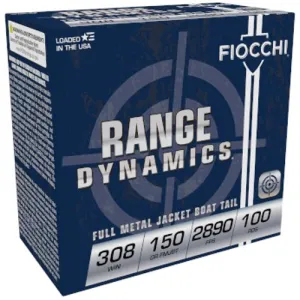
FIOCCHI Range Dynamics 308 WIN 150gr FMJBT Ammunition | 100 Rounds
.308 Winchester · 150gr · 100 rds
That grid is shorter than the one above it, and that is the finding. Deep bulk inventory in this cartridge is thin compared to 5.56 — see our 5.56 and .223 guide for the contrast, where 500- and 1,000-round cases are routine rather than exceptional. If you shoot .308 in volume, the constraint is usually availability of case quantities, not headline price.
Supply is also why prices in this cartridge move the way they do. The five forces behind ammo price spikes apply here with one extra wrinkle: a meaningful share of the cheap end depends on imports, so availability at the bottom of the market is less stable than at the top.
What should actually drive the buying decision?
Not the headstamp. In order:
- Purpose. Ball ammunition for practice, expanding bullets for game, match bullets for precision. This single choice sets most of your cost.
- Pack size. Case quantities beat boxes when they exist. Run the numbers rather than assuming.
- Delivered price, not sticker price. Hazmat and shipping thresholds move the real figure more than a few cents of list price does, and some destinations have restrictions worth confirming — our shipping restrictions guide covers how to check before you order.
- Label, last. If a 7.62x51-marked box of ball is cheaper than the equivalent .308-marked box this week, and your rifle is marked .308, buy the cheaper one.
If you are choosing the cartridge itself rather than the ammunition, the comparison worth reading is .308 versus 6.5 Creedmoor, which is a genuine ballistic and cost decision rather than a labeling one. And for the full picture of what to actually feed a .308, our best .308 ammo guide ranks the catalog by use case.
For the structurally identical argument one caliber down — where the safety direction genuinely does run one way — read .223 vs 5.56. That pairing is the one where chamber differences deserve real caution, and the contrast is instructive.
How we arrive at these numbers
Every figure on this page is pulled from live retailer listings at the moment you load it, normalized to cost per round, and filtered to exclude the storage boxes and reloading components that otherwise pollute a caliber's floor. We do not fire ammunition ourselves and we do not publish velocity or accuracy claims of our own — our ranking methodology sets out exactly what we will and will not assert.
You can browse the whole market for both labels together on our .308 and 7.62x51 NATO deals page, which deliberately lists them as one market, because for buying purposes that is what they are.
Get alerted when .308 Winchester price drops hit.
We watch every listing and email you the moment the cost per round drops.
Set Up a Free Price AlertAmmoSpotter earns a commission when you buy through links on this page. It never changes what you pay, and it never decides what we recommend — our picks are ranked on live cost-per-round data pulled from every retailer we track. Full disclosure.
Frequently Asked Questions
Can I shoot 7.62x51 NATO ammunition in a .308 Winchester rifle?+
Is .308 Winchester safe in a rifle marked 7.62x51 NATO?+
Is 7.62x51 NATO loaded to a lower pressure than .308 Winchester?+
Why does 7.62x51-labelled ammunition often price differently from .308?+
Do .308 and 7.62x51 use the same magazines, dies and chamber brushes?+
Does the headstamp matter for hunting accuracy?+

About the author
AmmoSpotter Research Desk
Price & Ballistics Research
The AmmoSpotter Research Desk analyzes live retail pricing across every ammunition, firearm and accessory listing we track. Recommendations here are ranked against real cost-per-round data pulled daily from the retailers we monitor - not against manufacturer marketing copy.
- ✓Tracks 180,000+ live product listings across 6 retailer feeds
- ✓Records price history on every listing, every day
- ✓Cost-per-round methodology applied to all ammunition rankings
- ✓No product is ranked without a verifiable in-stock retail price
- ✓Affiliate relationships never influence rankings
Related Guides

Best .308 Winchester Ammo 2026: Hunting, Match and Practice Loads on Live Prices
- .308 is really two markets. The cheap tier lives near the live floor; the hunting and match tier sits multiples above it. The catalog average describes neither. - Steel-case FMJ sets the price floor for this cartrid...

.223 vs 5.56: The Difference That Actually Matters
The cases are dimensionally near-identical. The ammunition will chamber in either rifle. That is exactly why this matters — nothing physically stops you from making the mistake. The two real differences 1. Pressure 5....

.308 vs 6.5 Creedmoor: What the Live Price Data Actually Says
- On catalog average the two cartridges cost essentially the same. .308 averages $1.945 per round across our listings; 6.5 Creedmoor averages $1.913. - The real gap is at the bottom. .308's floor is $0.650 per round; ...

Steel Case vs Brass Case Ammo: What You Actually Give Up
Steel-cased ammunition occupies a strange place in shooting culture: universally used, frequently condemned, rarely analyzed. The honest position is narrower than either camp claims. Steel is cheaper. It is cheaper fo...
.30-06 vs .308: Which Should You Buy, on Live Prices and Real Availability
This argument is older than almost everyone having it. The .30-06 Springfield has been in continuous use since before the First World War; the .308 Winchester arrived four decades later doing nearly the same job in a ...
Best .300 Blackout Ammo 2026: Supersonic and Subsonic on Live Prices
.300 Blackout exists to solve one problem: fitting a heavy, slow bullet into an AR-15 that cycles reliably with nothing changed but the barrel. It does that well. What it does not do is cost the same as feeding the ri...