Effective Range by Caliber: An Honest Table
Effective range is set by three limits at once — the cartridge, the shooter, and what practice costs per round. Only one of those is printed on the box.
Effective range is three limits stacked, and the cartridge is rarely the binding one
Every range chart on the internet treats effective range as something a cartridge has, like case capacity. It isn't. It is the shortest of three separate ceilings, and whichever one you hit first is your real answer.
The first is terminal: the distance at which the projectile still arrives fast enough to do the job it was designed for. That threshold is a property of the bullet, not the cartridge — the same case necked to the same diameter can have two very different answers depending on construction. We unpack how velocity and energy actually interact in muzzle energy vs muzzle velocity.
The second is dispersion: how far out your group is still smaller than the target. This one belongs to the shooter, the optic and the rifle, roughly in that order.
The third is economic, and it is the one nobody charts. Hit probability at distance is bought with repetitions. Repetitions are bought with ammunition. So the practical effective range of a cartridge, for a specific person, is capped by what that person can afford to shoot in a year — which is exactly the number our price data exists to answer.
The honest table: what each cartridge is built to do, and what feeding it costs
Two columns nobody puts side by side. The range band is conventional wisdom. The floor price is the cheapest live cost per round we were tracking across all monitored retailers on the date shown — not an average, not an MSRP, and not a number we invented.
| Cartridge | Conventionally quoted band | What actually limits it first | Market floor / round (Sep 28, 2026) |
|---|---|---|---|
| .22 LR | 50–75 yd on small game | Wind drift and a low, looping trajectory | $0.058 |
| 9mm | 25 yd defensive, 50 yd with practice | The shooter, almost entirely | $0.240 |
| .45 ACP | 25 yd defensive | Trajectory drop past 50 yd | $0.370 |
| .38 Special | 25 yd | Velocity from short revolver barrels | $0.420 |
| .357 Magnum | 50–100 yd from a carbine | Sight radius and recoil recovery | $0.544 |
| 12 Gauge (buck/target) | 25–40 yd buckshot, further with slugs | Pattern spread, not energy | $0.360 |
| 7.62x39mm | 200–300 yd | Rainbow trajectory past 250 yd | $0.350 |
| .223 Remington | 300–500 yd | Bullet weight and twist rate | $0.450 |
| 5.56x45mm NATO | 300–500 yd | Barrel length and load selection | $0.480 |
| .300 Blackout | ~200–300 yd supersonic, shorter subsonic | Velocity loss; subsonic drops fast | $0.700 |
| .308 Winchester | 600–800 yd | Wind, and the shooter's wind call | $0.650 |
| .30-06 Springfield | 500–600 yd hunting | Recoil-driven shooter fatigue | $0.850 |
| 6.5 Creedmoor | 800–1,000+ yd | Cost per round, for most owners | $0.950 |
Read the last two columns together and the shape of the problem appears immediately. The cartridges with the longest quoted bands are the ones you can least afford to shoot enough to reach those bands. That is not a coincidence — it is the whole story.
Why the pistol rows look so short
Handgun rows in most range charts are inflated because they quote what the cartridge can do on a bench. In practice the pistol number is a shooter number. Nothing about 9mm stops working at 40 yards; the person holding it does.
Which is good news, because it means the fix is cheap. Rimfire and 9mm sit at the bottom of the price table by a wide margin, so the caliber whose range is most shooter-limited is also the caliber where extra repetitions cost the least. That is the single best value trade in the whole chart.
9mm Luger Price Index
Live · Sep 28, 2026Cheapest Bulk 9mm Practice Ammo Right Now
Prices updated Sep 28, 2026
Winchester USA Forged 9mm 115 Grain 1000-Rounds Bulk FMJ
9mm · 115gr · 1,000 rds

CCI Ammunition Blazer Aluminum 9mm 115-Grain 1000-Rounds Bulk FMJ
9mm · 115gr · 1,000 rds

Winchester Centerfire Handgun Brass 9mm 115-Grain 1000-Rounds FMJ Bulk
9mm · 115gr · 1,000 rds

PMC Ammunition Bronze Brass 9mm 124 Grain 1000-Rounds Bulk FMJ
9mm · 124gr · 1,000 rds

PMC Ammunition Bronze Brass 9mm 115-Grain 1000-Rounds Bulk FMJ
9mm · 115gr · 1,000 rds
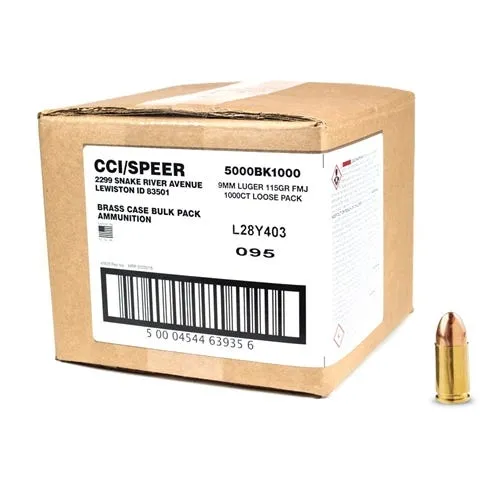
CCI Ammunition Blazer Brass 9mm 115-Grain 1000-Rounds FMJ Bulk Case
9mm · 115gr · 1,000 rds
If you want the same effect for a fifth of the money, do it in rimfire. A .22 LR trainer removes recoil from the equation and lets you shoot volume — see best .22 LR ammo for the bulk tier, and how many rounds it takes to get good for what volume actually buys.
.22 LR Price Index
Live · Sep 28, 2026Load selection still matters once you are past pure repetition work — our best 9mm ammo breakdown separates range fodder from carry loads, because the two have almost nothing to do with each other beyond bore diameter.
Where 5.56, 7.62x39 and .300 Blackout stop agreeing
Inside 150 yards these three are close enough that the argument is about rifles, not cartridges. Past that they diverge hard, and each one diverges for a different reason.
5.56 holds the flattest trajectory of the three, which is why its quoted band runs furthest. But that band swings by hundreds of yards depending on what you load: light practice bullets bleed velocity fast, heavier match projectiles hold it. The variable is the bullet's drag profile, which we cover in ballistic coefficient explained, and the barrel it leaves — barrel length changes velocity more than most people budget for.
7.62x39 arrives with more mass and leaves with less speed. Its limit is trajectory: holdovers get steep enough past 250 yards that field shooting turns into guesswork without a ranging solution.
.300 Blackout was never a distance cartridge. Its supersonic band is respectable and its subsonic band is short by design — that is the trade you are buying, and it is a good trade if the goal is a suppressed short barrel rather than a 400-yard hit.
5.56 & .223 Price Index
Live · Sep 28, 20267.62x39 Price Index
Live · Sep 28, 2026Notice that the two price floors sit close together while the quoted range bands do not. If the distance matters to you, the carbine cartridges are the point in the whole table where extra range costs the least per round. Browse the full catalog at 5.56 and .223 deals by cost per round, or start from our best 5.56 and .223 ammo guide.
Bulk 5.56 & .223: Lowest Cost Per Round
Prices updated Sep 28, 2026
Wolf Military Classic Steel .223 Rem 55 Grain 500-Rounds Bulk FMJ
.223 Remington · 55gr · 500 rds

PMC Ammunition Bronze .223 Rem 55 Grain 1000-Rounds FMJ Bulk
.223 Remington · 55gr · 1,000 rds

Wolf Performance Ammo PolyFormanc Steel Bulk .223 Rem 55 Grain 500-Rounds
.223 Remington · 55gr · 500 rds

Red Army Standard Centerfire Rifle Steel .223 Rem 55-Grain 500-Rounds Bulk FMJ
.223 Remington · 55gr · 500 rds

PMC Ammunition X-Tac Rifle Brass 5.56 55 Grain 1000-Rounds FMJBT Bulk
5.56x45mm NATO · 55gr · 1,000 rds

Winchester M855 5.56 Bulk Ammo 62 Grain FMJ 1000rds (Unpainted Tip) - WM8551000
5.56x45mm NATO · 62gr · 1,000 rds
Past 500 yards you are buying trigger time, not a cartridge
The long rows in the table are where the economics bite hardest. A cartridge with a four-figure quoted range is not useful to someone who shoots 60 rounds a year through it, because wind calls are a perishable skill and the practice that maintains them is the expensive part.
.308 Winchester Price Index
Live · Sep 28, 20266.5 Creedmoor Price Index
Live · Sep 28, 2026Run the two floors against each other and the annual difference for a serious practice schedule is not a rounding error. There is a real workaround, and it is visible in the catalog: steel-case .308 practice ammunition sits well below the brass-case tier, which lets you separate position and trigger practice from load verification practice and only pay match prices for the second one.
Lowest Cost Per Round: .308 and 6.5 Creedmoor
Prices updated Sep 28, 2026
BARNAUL AMMO 308 WIN 145Gr FMJ Poly Coated Steel Case 20rd
.308 Winchester · 145gr · 20 rds

BARNAUL AMMO 308 Win 140gr SP Polycoated Steel Case 20rd
.308 Winchester · 140gr · 20 rds

BARNAUL AMMO 308 Win 145Gr FMJ Zinc Steel Case 20rd
.308 Winchester · 145gr · 20 rds

BARNAUL AMMO 308 Win 150Gr HPBT Polycoated Steel Case 20rd
.308 Winchester · 150gr · 20 rds

BARNAUL AMMO 308 Win 168Gr SPBT Polycoated Steel Case 20rd
.308 Winchester · 168gr · 20 rds

BARNAUL AMMO 308 Win 168Gr FMJBT Polycoated Steel Case 20rd
.308 Winchester · 168gr · 20 rds
Cost Per Round Calculator
The only number that matters when comparing ammo. Shipping included.
Full inventory for both sits on the .308 and 7.62 caliber page, and the broader ammo catalog sorts every cartridge in the table above by live cost per round.
Three things that will make the table wrong for you
A suppressor changes the inputs. Cans shift point of impact, sometimes velocity, and in the subsonic case the entire terminal equation. If a can is in your plan, read the suppressor buying guide before you pick a cartridge around a range number, and verify current federal and state requirements yourself — they change, and they differ by jurisdiction.
Altitude and weather move the bands. Thin air extends them; cold, dense air and crosswind compress them. Any figure in the table is a sea-level-ish convention, not a constant.
The cheapest listing may not be deliverable to you. Hazmat handling and state-level restrictions can erase a price advantage entirely. Check before you build a practice budget on a floor price — ammo shipping restrictions explains how to verify it for your address.
And the floor itself is a moving target. Component costs, import policy and demand shocks push these numbers around continuously, which is why the blocks above render live instead of being typed into the text. Why ammo prices move covers the five forces behind every spike, and what happens when a new cartridge launches explains why a brand-new cartridge's quoted range band is always more impressive than its supply situation.
The version of this table you should actually build
Take the three rows you are choosing between. Ignore the middle column for a moment. Multiply each floor price by the number of rounds you will honestly shoot this year, and compare those three numbers. Then ask which cartridge lets you shoot enough to reach the distance it advertises.
For most shooters, most of the time, the answer is one row higher in the table than the one they wanted.
Get alerted when 5.56x45mm NATO price drops hit.
We watch every listing and email you the moment the cost per round drops.
Set Up a Free Price AlertAmmoSpotter earns a commission when you buy through links on this page. It never changes what you pay, and it never decides what we recommend — our picks are ranked on live cost-per-round data pulled from every retailer we track. Full disclosure.
Frequently Asked Questions
What is the difference between maximum range and effective range?+
How far is 5.56 effective?+
Does a longer barrel increase effective range?+
Which caliber has the best effective range for the money?+
Is buckshot effective past 25 yards?+
Do these range figures come from AmmoSpotter testing?+

About the author
AmmoSpotter Research Desk
Price & Ballistics Research
The AmmoSpotter Research Desk analyzes live retail pricing across every ammunition, firearm and accessory listing we track. Recommendations here are ranked against real cost-per-round data pulled daily from the retailers we monitor - not against manufacturer marketing copy.
- ✓Tracks 180,000+ live product listings across 6 retailer feeds
- ✓Records price history on every listing, every day
- ✓Cost-per-round methodology applied to all ammunition rankings
- ✓No product is ranked without a verifiable in-stock retail price
- ✓Affiliate relationships never influence rankings
Related Guides

Muzzle Energy vs Muzzle Velocity: What Actually Matters
Every ammunition box prints a velocity figure, and most print an energy figure next to it. Both are real. Both get used to argue things they cannot support — that one cartridge "hits harder," that a lighter bullet is ...
Ballistic Coefficient Explained: What BC Buys You, and What It Costs
Ballistic coefficient is the number that sells long-range ammunition, and it is one of the most consistently misread specifications in the business. It is not a quality rating. It is not an accuracy rating. It does no...
How Barrel Length Changes Velocity — And What It Should Change About Your Ammo
- Shorter barrel, same load, less velocity. That part is physics and it only runs one way. - The velocity printed on the box was measured in a test barrel. Unless yours matches that length, the number is not yours. - ...

How Many Rounds Does It Take to Get Good?
Almost every shooter is round-count constrained and almost none of them have written the number down. Ammunition is the actual budget line that determines how much you improve, and it is the one people plan least. So ...

Terminal Ballistics: Expansion, Penetration and What Gel Tests Show
- Ballistic gelatin is a calibration medium , not a tissue substitute. It exists so two bullets can be compared fairly, not so a number can be quoted at you. - Expansion and penetration trade against each other. The p...
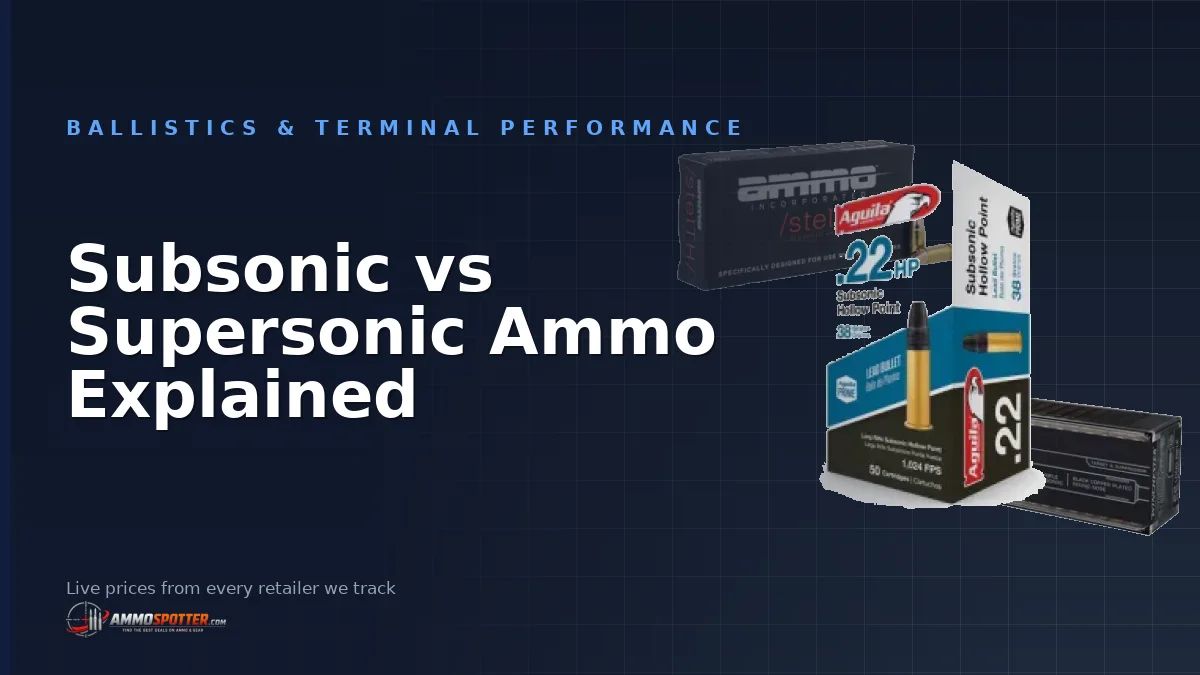
Subsonic vs Supersonic Ammo Explained: What Actually Goes Quiet
- Subsonic means the bullet stays under the speed of sound, roughly 1,125 fps at sea level. That is the entire definition. - It removes the sonic crack. It does not remove the muzzle blast or the action noise, so subs...