AR-15 Ammo Guide: What to Feed It and Why
Chamber marking, twist rate and job decide what belongs in your AR-15. Live cost per round decides how much of it you get to shoot.

The rifle is the cheap part. Over any realistic ownership period an AR-15 costs less than the ammunition that goes through it, which means the ammunition decision is the expensive one — and it is the one most buyers make by grabbing whatever is on the shelf.
There are only three questions that matter. What is your rifle chambered in, what will its barrel stabilize, and what job is this particular ammunition doing. Everything else is price, and price is the part we can show you live.
What is your AR-15 actually chambered in?
Read the barrel. This is not a formality.
.223 Remington is the commercial cartridge and the lower-pressure standard. 5.56x45mm NATO is the military specification: same external case dimensions, loaded to a higher pressure, and paired with a chamber cut with a longer throat ahead of the case mouth. .223 Wylde is a hybrid chamber designed to accept both while retaining accuracy with match .223.
The practical rule, and it only runs one way: a 5.56 NATO chamber handles .223 Remington without issue. A chamber cut for .223 Remington is not built around 5.56 NATO pressures, and the standard guidance is not to feed it 5.56. Follow the marking on your barrel and your rifle manufacturer's own guidance — that is the authority here, not a general rule from an article.
If you want the full dimensional and pressure comparison, .223 vs 5.56 covers it properly. For the two most common military-profile loadings and how they differ in construction, see M193 vs M855.
What does your twist rate let you shoot?
The second number stamped on most barrels is the rifling twist — 1:7, 1:8, 1:9 or 1:12, meaning one full rotation in that many inches.
The relationship is straightforward: faster twist rates impart more spin and stabilize longer, heavier bullets; slower twists suit shorter, lighter ones. A 1:12 barrel sits at the slow end and is generally a light-varmint-weight proposition. 1:9 covers the common middle. 1:8 is the current default on most general-purpose rifles. 1:7 is the fast end and is what you want if heavier match or defensive projectiles are the point of the rifle.
Two caveats worth stating plainly. Stability depends on bullet length and construction, not weight alone, so two bullets of the same grain weight can behave differently. And an over-stabilized light bullet is a far smaller problem than an under-stabilized heavy one. Where you are near the edge of a barrel's range, ask the barrel maker rather than guessing.
What does .223 and 5.56 actually cost right now?
This is where a guide either has data or has opinions.
.223 / 5.56 NATO Price Index
Live · Nov 18, 2026That block queries our catalogue when the page loads. At the time of writing we track 380 approved .223 Remington listings carrying a computed cost per round, which is what makes a market floor meaningful rather than anecdotal — one cheap listing is noise, several hundred is a market.
One thing the brand-level data shows that shelf browsing does not: at the bottom of the market the major names sit remarkably close together. When this was written, the cheapest tracked listing from Remington was $0.500 per round, Hornady $0.512 and Winchester $0.518 — a spread of under two cents across three brands. Brand loyalty at the practice tier is worth very little. Loading, case material and pack size move the number far more than the name on the box.
The practice load: buy it by the case
Most of what goes through an AR-15 is 55 or 62 grain full metal jacket, and the only meaningful decisions are pack size and case material.
Bulk .223 / 5.56 by Cost Per Round
Prices updated Nov 18, 2026
Patriot Sports Rifle Ammunition .223 Rem 55 Grain 1000-Rounds FMJ
.223 Remington · 55gr · 1,000 rds

PMC Ammunition Bronze .223 Rem 55 Grain 1000-Rounds FMJ Bulk
.223 Remington · 55gr · 1,000 rds

Wolf Military Classic Steel .223 Rem 55 Grain 500-Rounds Bulk FMJ
.223 Remington · 55gr · 500 rds

Wolf Performance Ammo PolyFormanc Steel Bulk .223 Rem 55 Grain 500-Rounds
.223 Remington · 55gr · 500 rds

PMC Ammunition X-Tac Brass 5.56 NATO 62-Grain 1000-Rounds GT Bulk
5.56x45mm NATO · 62gr · 1,000 rds

PMC Ammunition X-Tac Rifle Brass 5.56 55 Grain 1000-Rounds FMJBT Bulk
5.56x45mm NATO · 55gr · 1,000 rds
Case quantities win on packaging and shipping efficiency, which is why the bottom of that list is almost entirely 500- and 1,000-round packs. If you are not ready to commit to a case, the same sort across smaller packs shows what the entry point costs:
Cheapest .223 / 5.56 in Any Pack Size
Prices updated Nov 18, 2026
BARNAUL AMMO 223/5.56 62Gr FMJBT Steel Case 20rd
.223 Remington · 62gr · 20 rds

BARNAUL AMMO 223 Rem 55Gr HPBT Polycoated Steel Case 20rd
.223 Remington · 55gr · 20 rds

BARNAUL AMMO 223 Rem 62Gr SPBT Polycoated Steel Case 20rd
.223 Remington · 62gr · 20 rds
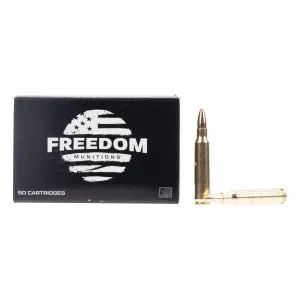
Freedom Munitions Range 223 Rem 62gr FMJ Ammo - Box of 50
.223 Remington · 62gr · 50 rds
Patriot Sports Rifle Ammunition .223 Rem 55 Grain 1000-Rounds FMJ
.223 Remington · 55gr · 1,000 rds
PMC Ammunition Bronze .223 Rem 55 Grain 1000-Rounds FMJ Bulk
.223 Remington · 55gr · 1,000 rds
For which specific loads are worth buying at those prices, best 5.56 and .223 ammo does the selection work, and the .223 / 5.56 caliber page carries every listing we track.
Steel case or brass: the cost lever most people ignore
Steel-cased ammunition is consistently the cheapest way to feed a .223 chamber, and the reason is exactly what it looks like — steel is cheaper than brass.
The trade is real. Steel cases are harder and do not obturate to seal the chamber quite the way brass does, which changes fouling behavior. Steel-cased ammunition is also typically loaded with a bimetal jacket, which is harder on a bore over a long round count than a copper jacket. Neither of these makes it unusable; plenty of people put enormous volumes of it through practice rifles deliberately.
There are two situations where it is the wrong call. If you reload, every steel case is brass you did not recover, and that changes the arithmetic completely — see is reloading still cheaper than buying ammo. And if the rifle is a precision build you intend to keep barrel life on, the savings are not worth the wear. Steel case vs brass ammo works through both cases.
The defensive load: what actually changes
Practice ammunition and defensive ammunition are solving different problems, and the price comparison between them is close to meaningless.
Full metal jacket practice ammunition is built to be cheap, consistent and reliable. A defensive load is built around terminal behavior and, in the AR-15's case, often around performance through intermediate barriers. That is a design goal, not a price tier, and it is why the cost per round is several times higher.
We do not test ammunition. There are published protocols the industry uses for terminal evaluation, and where a manufacturer publishes results against them, that is the source worth reading — not us, and not a round-up article. What we can tell you is what each load costs and who has it.
Buy defensive ammunition in small quantities, confirm it feeds and functions reliably in your rifle, and replace it on a schedule. Best 5.56 ammo for home defense covers the selection considerations, including the ones specific to shooting inside a structure.
What about .300 Blackout, 9mm and .22 LR uppers?
The AR-15 lower receiver is a platform, and three alternative chamberings are common enough to plan around.
.300 Blackout exists to run heavy subsonic projectiles from a short barrel, which is why it is so closely tied to suppressor use. It costs more per round than .223, and the gap is visible live:
.300 Blackout Price Index
Live · Nov 18, 2026If suppressed shooting is the reason you are looking at it, read the suppressor buying guide first — the can, the wait and the paperwork dominate that decision far more than ammunition cost does. Also worth knowing why the cartridge exists at all: 5.56 vs .300 Blackout.
9mm pistol-caliber uppers turn the rifle into a cheap-to-run carbine, and 9mm is the highest-volume centerfire cartridge in the market — best 9mm ammo covers the loads, and the 9mm caliber page the live pricing.
.22 LR conversions and dedicated uppers are the cheapest trigger time available on the platform by a wide margin, and nothing else comes close on cost per round. For volume practice on fundamentals, it is the highest-leverage purchase on this page: best .22 LR ammo.
How much does a year of AR-15 shooting actually cost?
Multiply honestly. Annual round count times landed cost per round, where landed means shipping and any hazmat fee included, not the shelf price.
Cost Per Round Calculator
The only number that matters when comparing ammo. Shipping included.
Most people underestimate the round count and overestimate the price. If you have no idea what your annual volume should be, how many rounds it takes to get good is the more useful anchor than any figure a retailer quotes. And since range sessions are gated by how much you can load ahead of time, how many magazines you actually need is a genuine constraint on volume, not an accessory question.
While you are budgeting the rifle as a system: an optic is a one-time cost that changes every session, and ammunition is a recurring one. Red dot vs LPVO covers which side of that trade suits how you actually shoot.
The buying rules that save real money
Four, in order of how much they are worth.
Buy practice ammunition by the case, against cost per round. This is most of the available saving and it is available today.
Ignore the calendar, watch the floor. Ammunition prices move on demand shocks and component costs, not on a season — why ammo prices move covers the five forces that actually do it.
Check shipping and restrictions before you fill a cart. Hazmat fees, carrier rules and state or local restrictions can undo a good per-round price entirely. These vary by jurisdiction and change; verify the current rules for your address rather than assuming — ammo shipping restrictions explains how.
Let the market tell you. Set an alert on your cartridge instead of checking listings.
Get alerted when .223 Remington price drops hit.
We watch every listing and email you the moment the cost per round drops.
Set Up a Free Price AlertStart from all tracked ammunition sorted by cost per round, or go straight to the .223 / 5.56 caliber page for everything that fits the rifle you already own.
AmmoSpotter earns a commission when you buy through links on this page. It never changes what you pay, and it never decides what we recommend — our picks are ranked on live cost-per-round data pulled from every retailer we track. Full disclosure.
Frequently Asked Questions
What ammo does an AR-15 use?+
Can I shoot 5.56 in a .223 rifle?+
What twist rate do I need for heavy bullets?+
Is steel-cased ammo bad for an AR-15?+
How much ammo should I buy for an AR-15?+
What is the cheapest way to shoot an AR-15?+

About the author
AmmoSpotter Research Desk
Price & Ballistics Research
The AmmoSpotter Research Desk analyzes live retail pricing across every ammunition, firearm and accessory listing we track. Recommendations here are ranked against real cost-per-round data pulled daily from the retailers we monitor - not against manufacturer marketing copy.
- ✓Tracks 180,000+ live product listings across 6 retailer feeds
- ✓Records price history on every listing, every day
- ✓Cost-per-round methodology applied to all ammunition rankings
- ✓No product is ranked without a verifiable in-stock retail price
- ✓Affiliate relationships never influence rankings
Related Guides

AR-15 Ammo Guide: What to Feed It and What It Costs
An AR-15 is a one-time purchase. Ammunition is a subscription. Most people research the rifle for months and then buy whatever 5.56 is on the shelf, which is exactly backwards from where the money goes. This guide cov...

.223 vs 5.56: The Difference That Actually Matters
The cases are dimensionally near-identical. The ammunition will chamber in either rifle. That is exactly why this matters — nothing physically stops you from making the mistake. The two real differences 1. Pressure 5....

Best 5.56 & .223 Ammo 2026: Practice, Defense and Precision
5.56x45mm NATO and .223 Remington are the most-purchased rifle cartridges in America, and the most confusing to buy. The same rifle will accept ammunition ranging from bulk steel-cased plinking loads to match ammuniti...

M193 vs M855: Which 5.56 Should You Actually Buy?
The green tip looks like a premium tier. It is not. M855 is a specialized barrier round that trades close-range fragmentation and range access for the ability to punch through light steel — and it usually costs more t...

Best AR-15 Rifles at Every Budget (2026): What Each Tier Actually Costs
- The AR-15 market has three real price tiers, and the jump between them buys different things: the first buys a working rifle, the second buys a good one, the third buys durability under high round counts. - The chea...
Best AR-15 Magazines 2026: What 482 Live Listings Actually Cost
- We track 482 live AR-15 magazine listings. 263 of them sit between $10 and $20, which is the only price band that matters for most buyers. - Reduced-capacity magazines cost more than full-capacity ones, by median an...